ores.assets.core
Table of Contents
1. Diagram
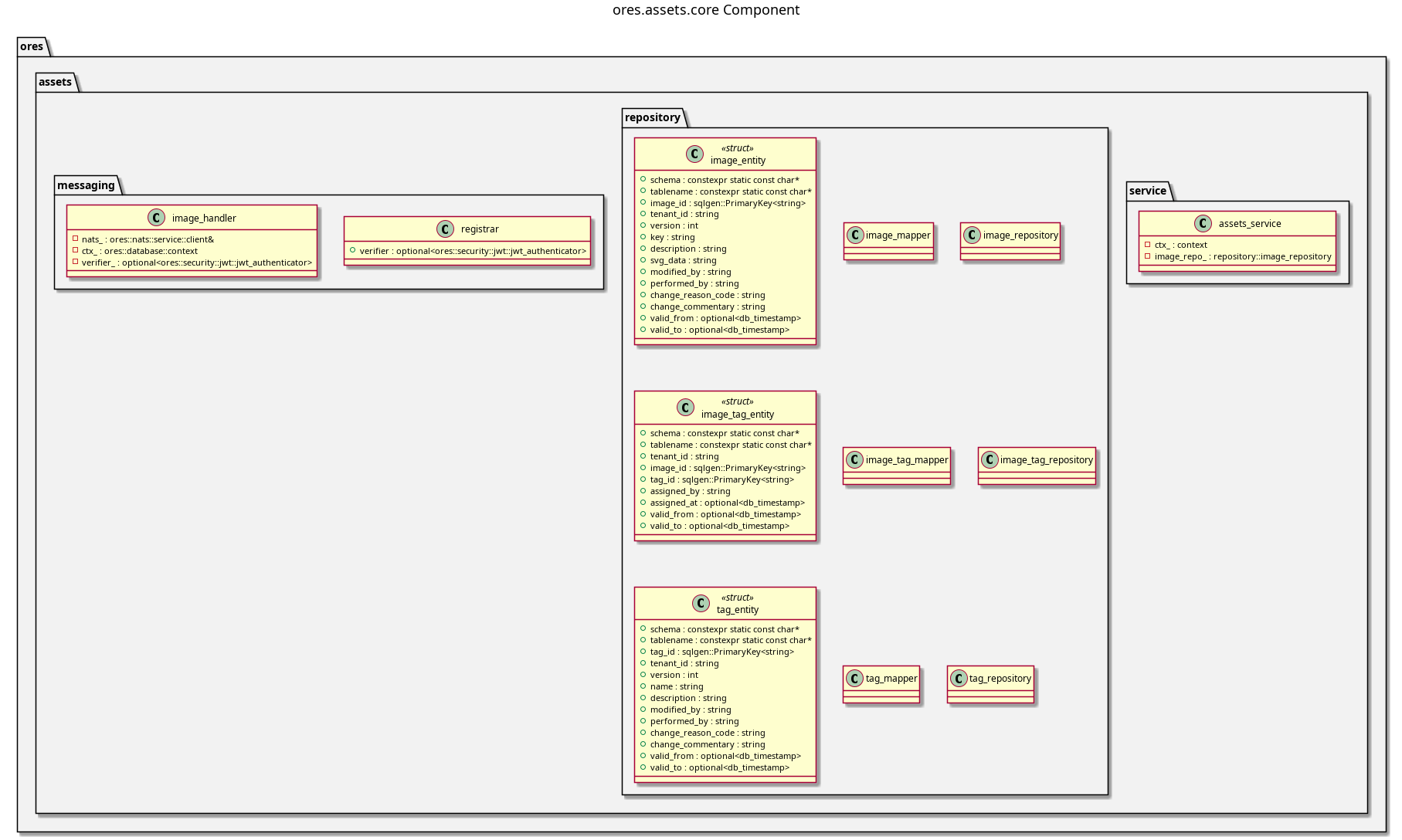
Figure 1: ores.assets.core
2. Summary
ores.assets.core manages dynamically loaded images (SVG), tags, image-tag
associations, and currency-to-image mappings in ORE Studio. It provides the
business logic and persistence layer — domain services, temporal ORM
repositories, and NATS message handlers in the 0x4000–0x4FFF range — that
let clients store, categorise, and retrieve asset images at runtime. It also
ships a synthetic-data generator for test and development use.
3. Inputs
- NATS request messages from UI clients (image create/update/query, tag operations, currency-image lookups) in the 0x4000–0x4FFF range.
- PostgreSQL connections to
ores_assets_*tables (images,tags,image_tags,currency_images) with temporal versioning. - DQ population events via
publish_from_dq_handlerwhen assets are loaded from the data-quality pipeline.
4. Outputs
- Image, tag, and association records persisted to the
ores_assetsschema with bitemporal history (valid_from/valid_to). - NATS response messages returned to callers.
5. Entry points
include/ores.assets.core/ores.assets.hpp— aggregate include.include/ores.assets.core/messaging/registrar.hpp— registers all NATS handlers with the service host.include/ores.assets.core/service/assets_service.hpp— top-level business logic entry point.
6. Dependencies
ores.assets.api— shared domain types and NATS protocol schemas.ores.dq— ORM base classes and data-quality infrastructure.ores.iam.core— identity and authorisation context.rfl— JSON serialisation via reflection.soci— SQL ORM for PostgreSQL persistence.nats.c— NATS messaging client.
7. See also
- ores.assets.api — protocol types and domain entities.
- ores.assets.service — NATS service entrypoint.
- ores.assets Messaging Reference — full NATS subject and message catalogue.