ores.ore.api
Table of Contents
1. Diagram
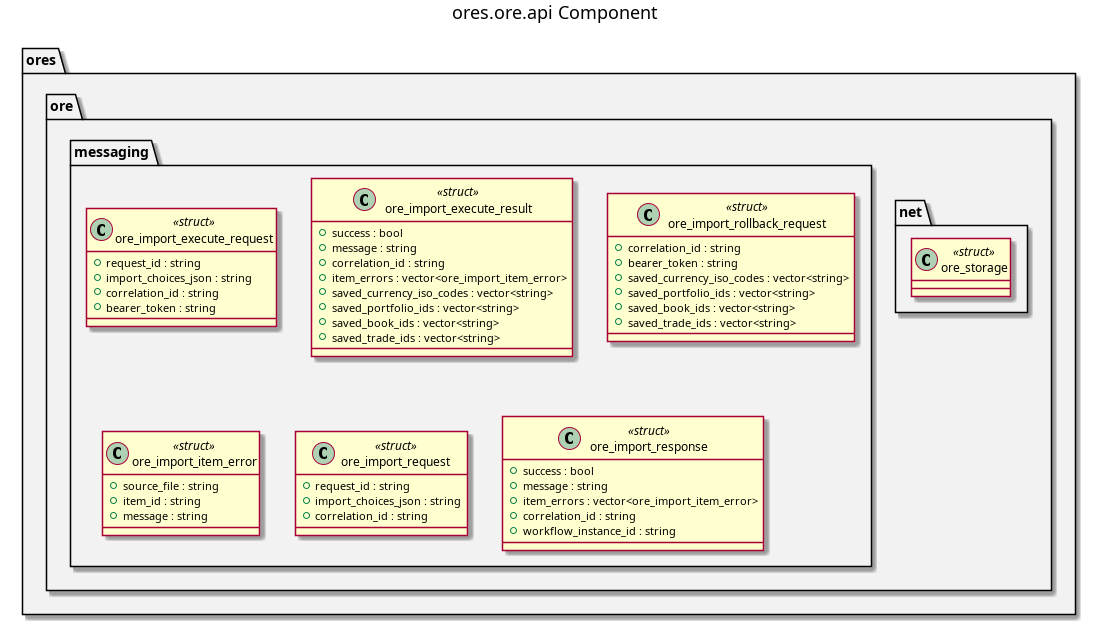
Figure 1: ores.ore.api
2. Summary
ores.ore.api is the shared contract of the component. It carries the
series key shape entity with its JSON I/O; the protocols for importing an
ORE directory, for the saga steps the engine drives, and for locating the
import tarball in object storage; and the workflow registration the ORE
import runs under.
The entity is the only part of the contract with no protocol of its own.
It is a reference table that ores.marketdata reads through the core's
repository, in process, so the model disables every facet that would build
a NATS surface, a shell command or a user interface for it. What the api
carries is the type the repository returns, not a surface.
It is a shared library, not a header-only one: the sources under src/
build ores.ore.api.lib and install it with a version.
3. Inputs
- Entity rows, from the core's repository.
- Protocol requests for the ORE import, and workflow definitions the engine registers at startup.
4. Outputs
- The entity type and its JSON serialisation, for the repository and the market data readers.
- The import, saga-step and storage protocol schemas consumed by
ores.ore.serviceand the shell.
5. Entry points
include/ores.ore.api/domain/— the series key shape entity and its JSON I/O.include/ores.ore.api/messaging/— the import and saga-step protocols.include/ores.ore.api/net/— the import tarball bucket and key helpers.include/ores.ore.api/workflow/— the ORE import workflow registration.
6. Dependencies
ores.platform,ores.storage,ores.logging,ores.workflow.apiandores.eventing.api— linked publicly, so consumers inherit them.ores.utility— linked privately.
ores.storage is public because the import target helpers name a bucket,
so every consumer of this part inherits the object-storage client.
7. See also
- ores.ore.core — the document engine behind this contract.
- ores.ore.service — the runnable host.
- ores.ore — the composite this part belongs to.
- ores.ore.series_key_shape — the entity this part carries, with no surface of its own.
- How do I round trip an ORE document through the database? — the import workflow this part declares.