ores.ore.service
Table of Contents
1. Diagram
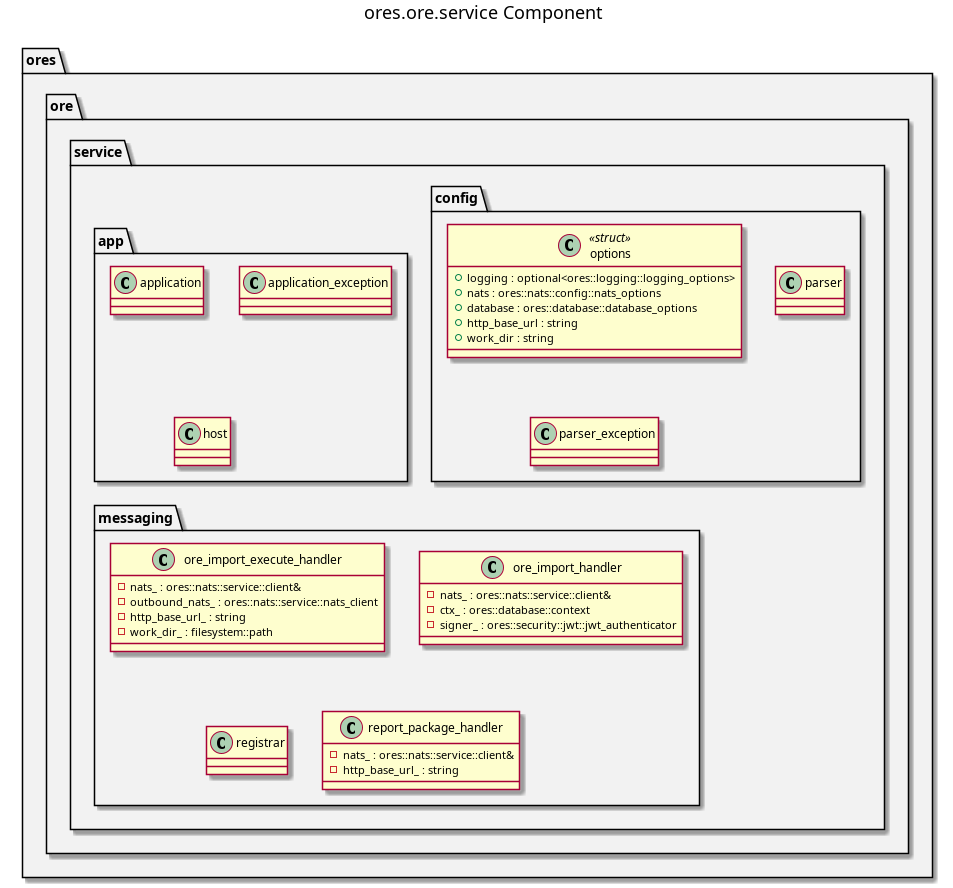
Figure 1: ores.ore.service
2. Summary
ores.ore.service is the runnable host of the component. It reads its
configuration, opens the NATS and database connections, subscribes the ORE
import subjects, and runs the service loop.
The import handlers are the part's substance: the worklist handler that stages an uploaded directory, the execute handler that plans and saves the documents into the trading and reference data model, the rollback handler, and the report package handler that assembles an ORE run's inputs.
The series key shape entity has no handler here or anywhere else, by
design. It is a reference table ores.marketdata reads through the core's
repository, in process, so the entity's model disables its protocol,
handler, registrars, service and shell command rather than leaving a
surface nothing composes.
3. Inputs
- Configuration: NATS, database, logging, the HTTP base URL and the work directory.
- NATS requests on
workflow.v1.ore.import,ore.v1.ore.import.executeandore.v1.ore.import.rollback, and the reporting package preparation. - The uploaded import tarball, fetched from object storage into the work directory.
4. Outputs
- Imported and rolled-back rows in the trading and reference data model.
- NATS responses carrying the import plan, the per-item outcome and any errors.
- A running service process.
5. Entry points
src/main.cpp— process entry point.src/app/— the application and its host.src/config/— the command line and environment parser.src/messaging/— the registrar and the import, execute, rollback and report package handlers.
6. Dependencies
ores.service,ores.nats,ores.database,ores.utility,ores.telemetry.coreandores.eventing.core— linked publicly.ores.ore.core,ores.ore.api,ores.storage,ores.workflow.api,ores.iam.client,ores.refdata.api,ores.trading.api,ores.reporting.apiand Boost — linked privately.
7. See also
- ores.ore.core — the engine the handlers drive.
- ores.ore.api — the protocol this part serves.
- ores.ore — the composite this part belongs to.
- How do I round trip an ORE document through the database? — the workflow an operator drives through this service.