ores.qt.party
Table of Contents
Diagram
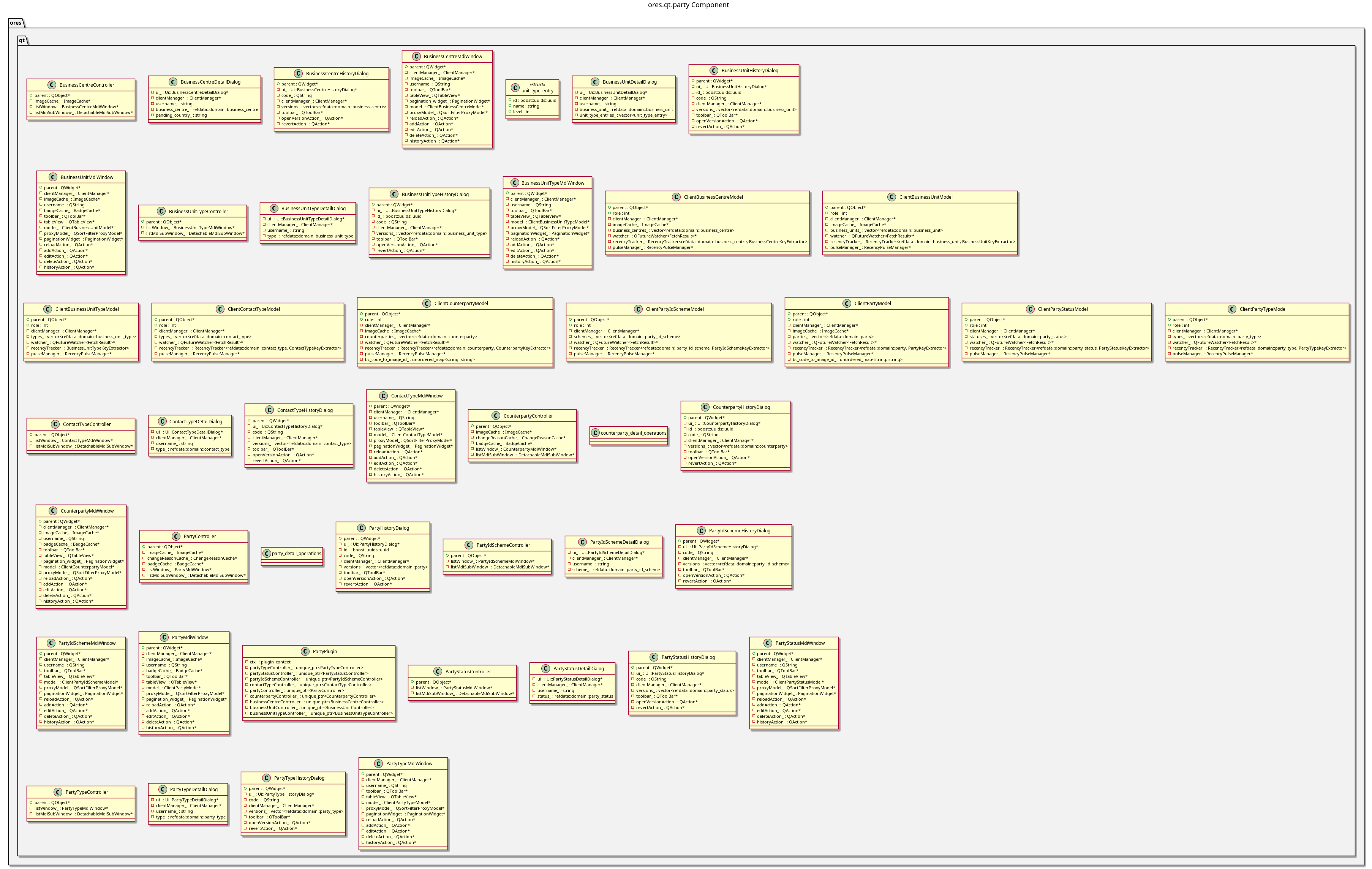
Figure 1: ores.qt.party
Summary
ores.qt.party is the Qt plugin for the party and organisation domain. It
provides MDI windows and dialogs for managing parties, counterparties, business
units, and business centres, and their supporting code types (party types,
party statuses, party ID schemes, contact types, and business unit types). It
contributes its entity actions to the Reference Data menu (owned by
ores.qt.refdata) via the setup_menus phase.
Inputs
- NATS responses for party, counterparty, business unit, business centre, and organisation code entities.
- User interactions: create/edit/delete/view-history on party entities.
shared_menus_context.reference_data_menupointer for contributing items.
Outputs
- Rendered MDI windows for party and organisation entities.
- NATS request messages sent to the relevant party services on user actions.
- Parties, Counterparties, Business Centres, Business Units, and Organisation Codes submenu items contributed to the Reference Data menu.
Entry points
include/ores.qt/PartyPlugin.hpp— plugin class; contributes to Reference Data menu.include/ores.qt/PartyController.hpp— party entity controller.include/ores.qt/CounterpartyController.hpp— counterparty entity controller.include/ores.qt/BusinessUnitController.hpp— business unit controller.
Dependencies
ores.qt.api— IPlugin, base controller/window/dialog classes, ClientManager.ores.refdata.api— reference data domain types used in party classification.ores.storage— storage abstraction for party data persistence.
See also
- ores.refdata.api — reference data domain types shared with party entities.
- ores.qt.refdata — owns the Reference Data menu that party contributes to.
- ores.qt.api — shared Qt infrastructure and base classes.
- Qt Plugin Architecture — plugin lifecycle and menu-contribution model.
- Entity Controller Pattern — controller/window/dialog/model structure.