ores.reporting
Table of Contents
1. Diagram
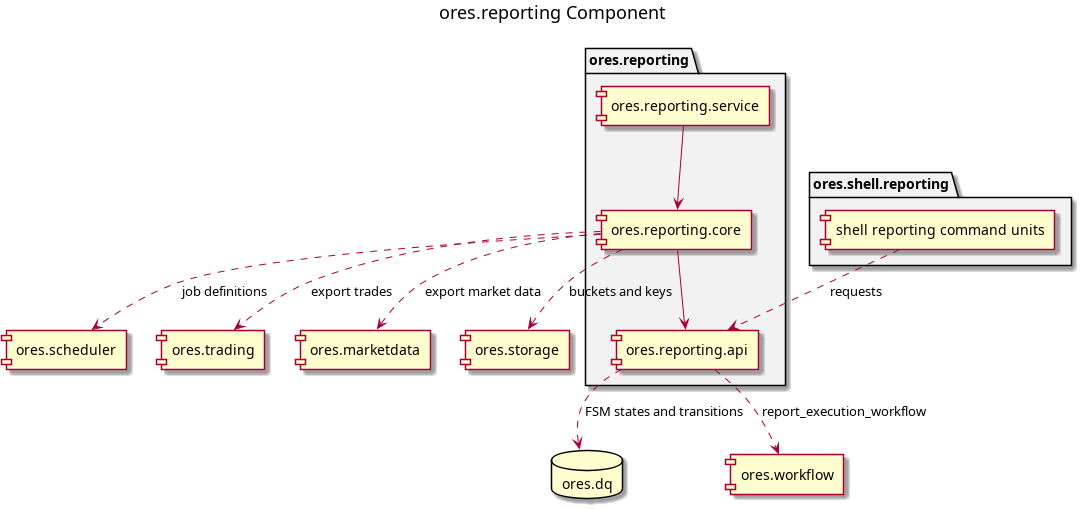
2. Summary
ores.reporting decides what a report is, when it runs, and what happened when
it did. It owns report definitions, report types, concurrency policies, risk
report configurations, report instances and the input bundles an execution
gathers.
It is a composite: the component has no code of its own, and every generated and hand-written artefact lives under one of the three parts below.
A report instance moves through the report_instance_lifecycle state machine,
which the component seeds. The states and transitions live in ores.dq, and a
trigger on the instances table refuses a state change the machine does not
allow.
3. Inputs
- NATS requests for the entity verbs of its six models: report types, report
definitions, report instances, concurrency policies, risk report
configurations, and the report definition templates it forwards to
ores.dq. reporting.v1.ops.trigger_report_instance– the scheduler sends it when a report job fires, and the shell sends it by hand. It carries the definition, the tenant that owns it and the scheduler run.- DQ artefacts published into report definitions by the provisioning flow.
- Workflow step completions from
ores.workflow, and batch completions fromores.compute, which resume a report that is waiting on the grid.
4. Outputs
report_instancerows and theirreport_input_bundlerows.report_execution_workflowstarts, dispatched toores.workflow.- Storage buckets and keys handed to
ores.tradingandores.marketdata, which write the gathered trades and market data themselves. - Scheduler job definitions, through
ores.scheduler. - Entity change events for the four models that carry them.
5. Entry points
projects/ores.reporting/api/– domain types, JSON and table I/O, the NATS protocols, and the workflow definition.projects/ores.reporting/core/– repositories, services, the messaging handlers and the component registrar.projects/ores.reporting/service/–ores.reporting.service, the process that owns the subscriptions.projects/ores.shell/reporting/– the shell command units that drive all of the above, including the trigger operation.
6. Dependencies
ores.dq– the FSM machines, states and transitions the lifecycle binds to.ores.workflow– the engine that runs a report execution.ores.scheduler.api– the job definitions the component creates and removes.ores.trading.apiandores.marketdata.api– the export requests that gather a report's inputs.ores.storageandores.http.server– where those exports land.ores.service– the runner, request context and messaging helpers every handler uses.ores.securityandores.iam.client– the JWT verifier and the service token the component presents to its peers.
7. See also
- Clean ores.reporting to the component clean standard – the pass that brought the component to the standard.
- Component Clean Standard – the checklist each item is recorded against.
- NATS entity protocol specification – the subject grammar the component follows, and the operation rules its trigger obeys.
- Journey execution – why a report execution is a workflow rather than a coordinator.