Job actions
Table of Contents
An action is the operation a firing performs. A job definition stores an action type and the payload that action type needs; at each firing the scheduler selects the handler registered for that type. Three types exist: a database statement, a queue message, and a published message. The action type decides whether the firing waits for a reply. This page defines the three types, the handler registry, and the limits of an action.
1. Detail
1.1. The handler registry
The action type is a string stored on the job definition. The scheduler registers one handler per type and selects the handler whose type matches the job's. The loop, the cron expression and the firing record do not depend on the set of types: adding a type adds a handler and changes no other component.
A job whose type has no registered handler fails immediately, before any work is attempted, and the scheduler's error is stored in the firing record. The refusal states that the job asks for something the scheduler cannot perform, which is a property of the job and not of the payload.
The registered types are execute_sql, send_mq_message and
nats_publish, and each reads its payload from the job definition.
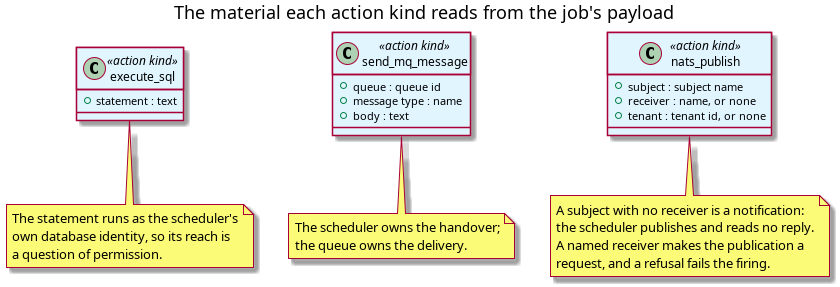
Figure 1: The payload each action type reads from the job definition: the statement, the queue message, and the published message with its optional receiver.
Source: scheduler_action_payloads.puml. Regenerate with
plantuml -tpng doc/knowledge/architecture/scheduler_action_payloads.puml.
1.2. The database statement
The execute_sql action runs a statement against the database. The
statement is stored on the job definition and passed to the database
unchanged, and it runs under the scheduler's own database identity, so
the privileges of a scheduled statement are the privileges of that
identity.
A statement the database rejects fails the firing, and the database's
error is stored in the record. The scheduler's queue-statistics job,
ores.mq.metrics_scrape, uses this type every minute; a system job that
maintains derived data is the usual case for it.
1.3. The queue message
The send_mq_message action stores a queue identifier, a message type
and a body in the job payload, and asks the queue component to accept the
message. The scheduler owns the handover and not the delivery: ordering,
redelivery and consumption belong to the queue component, and the
scheduler neither tracks the message nor learns whether it was consumed.
The firing completes when the queue accepts the message.
1.4. The published message
The nats_publish action stores a subject and publishes the job's
payload on it. Two forms exist, and the payload selects between them.
- Notification. No receiver is named, so the scheduler publishes and reads no reply. The firing completes when the publish returns, and no component has to be subscribed for the action to succeed. This is the smallest action a job can perform, and A first schedule uses it as its example.
- Request. A receiver is named, so the scheduler sends an authenticated request under its own service identity. The receiver can name the caller, and an error reply fails the firing, which is how a rejected trigger reaches the schedule instead of being lost. The scheduler waits for the acknowledgement and for nothing else: the work the receiver performs is not part of the firing.
The scheduler's stale-result reaper, compute.v1.reap.stale_results,
publishes on compute.v1.ops.reap_work every minute in the notification
form. The request form belongs to a trigger whose acceptance matters; the
per-definition trigger that reporting registers is the case in service.
1.5. The limits of an action
The scheduler runs one action per firing and records its result. It does not retry an action that failed, and it does not track the work an action starts. Both limits follow from the same rule: the scheduler's responsibility ends when the action returns, and the receiver owns everything after that. Scheduling and workflows defines the boundary for the case where the work behind a subject outlives one action.
2. Patterns used
- Request-Reply — the request form
of
nats_publishwaits for the trigger's acknowledgement. - Retry — the scheduler deliberately does not retry a failed action; the next occurrence is the next firing.
3. See also
- Scheduler — the structure note that orders this cluster, and where to read this page in it.
- NATS documentation — the transport the published action uses.