Request-Reply
Table of Contents
This page defines the service architecture pattern Request-Reply in the pattern language. A requester sends a message and receives one reply on an address the request names. In ORE Studio every service operation is a NATS request with a private inbox as its reply address.
1. Also known as
- Request-response.
- Return Address, the companion pattern in Hohpe and Woolf for the reply's destination.
2. Context
Services talk over a message bus, not direct connections. A caller needs an answer: data, a decision, or a refusal.
3. Problem
How does a service ask another for an answer over a bus that only moves one-way messages?
4. Forces
- The bus delivers messages one way; a reply needs an address.
- The caller must not wait forever for an answer that may never come.
- A refusal must be told apart from an answer, or a client decodes an error as data.
- Several replicas serve one subject, and only one should answer.
5. Solution
The requester creates a private inbox and sends the request with the inbox as its
reply address. One replica of the serving queue group receives it, acts, and
publishes one reply to the inbox. A refusal is a reply too: an empty body with an
X-Error header. The requester waits up to its timeout, reads X-Error first,
and only then decodes the body.
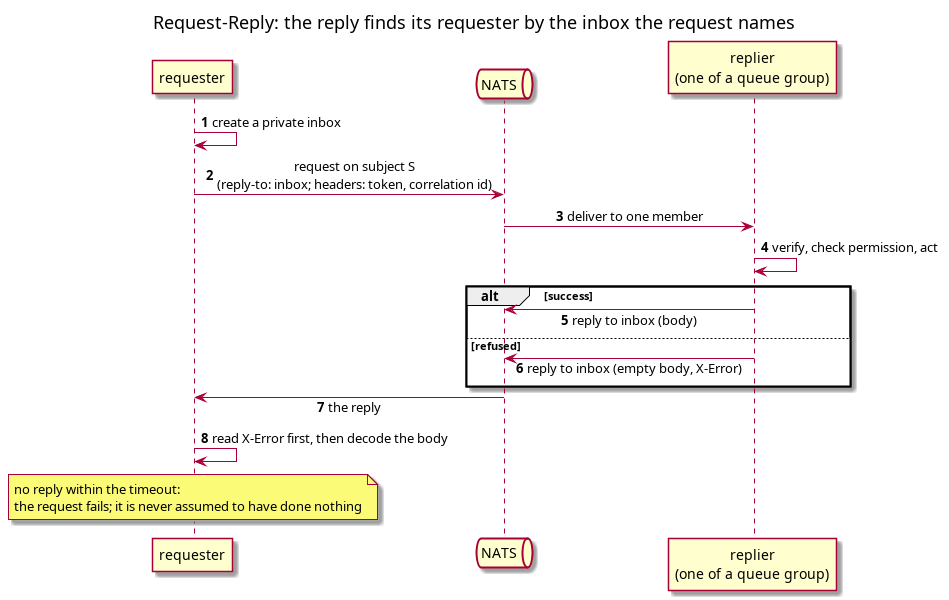
Figure 1: Request-Reply: the request names its inbox, one replica answers, and a refusal is an empty reply with X-Error.
Source: [[./pattern_request_reply.puml][pattern_request_reply.puml]]. Regenerate with
plantuml -tpng doc/knowledge/service_architecture_patterns/pattern_request_reply.puml.
6. Failure handling
| Concern | What the pattern does |
|---|---|
| Errors | A refusal is an X-Error reply: unauthorized, forbidden, bad_request or token_expired. A client reads the header before the body. |
| Timeouts | The requester waits at most its timeout; see Timeout. No reply does not prove the work was not done. |
| Retries | Only token_expired is retried, once, after a renewal; see Retry. |
| Idempotency | A repeated request is a new delivery; the replier must tolerate it if the operation writes. |
| Observability | The subject, the correlation id and the outcome are logged on both sides. |
7. Pitfalls
- A refusal decoded as a body. The client reports a decode error; the real cause is the
X-Errorheader it did not read. - No subscriber. A request to a subject nobody serves waits for its whole timeout and then fails, with nothing in any service's log.
- A long operation behind a request. Work that takes minutes holds the caller; it belongs in a workflow that answers at once with a run id.
- A timeout read as "nothing happened". The replier may have finished after the caller gave up.
8. Security
The request carries the caller's token, and the replier authorises it on every request. The inbox is private to the requester's connection, so another client cannot read the reply.
9. Resulting context
- Benefits
- A service call over the bus, with one answer and a clear refusal path.
- Liabilities
- The caller is blocked for the call's length, and a slow replier holds it.
10. In ORE Studio
The curve construction, Bootstrapping a curve: from quotes to a published set, is a request-reply: the compute reads the quotes and answers the solved points.
The surface construction, Constructing a volatility surface: from quotes to a published set, is one too: the calibration reads the quotes and answers the calibrated points and their errors.
The market data path, a public fixing, a curve and a report, is a chain of it: each hop calls a service and waits for the answer before the next.
The default timeout is 30 seconds, set once in ores.nats/service/timeouts.hpp for every overload.
- Anatomy of a Service — every service operation is a request with an inbox; a refusal is an empty reply with
X-Error. - Job actions — the request form of
nats_publishwaits for the trigger's acknowledgement. - How the compute grid queues and claims work — a node claims a job with a request and receives the assignment in the reply.
- The history call returns every tick of a range in one reply, or refuses the range — a client asks for a span of ticks and receives every tick of it in one reply.
11. Related patterns
- Timeout — bounds the wait.
- Correlation Identifier — joins the request and the reply in the logs.
- Competing Consumers — chooses which replica answers.
- Process Manager — the alternative for work that outlives a request.
12. NATS patterns
The NATS service patterns hub states how each of these is written in
ores.nats code:
- Bounded Request — every service operation is a bounded request with a stated deadline.
- Classify Transport Failure — a timeout, a no-responders signal and a refusal are three different outcomes.
- Report a Refusal Off the Body — a refused request is answered off the body, with an
X-Errorcode. - Report a Failure in the Body — a request the service handled is answered in the body.
- Never Let an Exception Cross the Bus — no exception may cross the reply boundary.
- Prefix Every Subject With make_subject — the request subject is environment-relative in code.
13. Sources
- Gregor Hohpe and Bobby Woolf, Enterprise Integration Patterns, Addison-Wesley, 2003, Request-Reply and Return Address.
- NATS documentation, Request-Reply.
14. See also
- Service architecture patterns — the structure note that orders this pattern language, and where to read this page in it.