Correlation Identifier
Table of Contents
This page defines the service architecture pattern
Correlation Identifier in the pattern language.
Each message carries an identifier that ties it to the action that caused it, so
the work one action spreads across services can be found together. In ORE Studio
the identifier travels in the Nats-Correlation-Id header, and every log line
written for a request should name it.
1. Also known as
- Correlation id, request id, and the
X-Request-IdorX-Correlation-Idheader of HTTP services. - Hohpe and Woolf define the pattern for matching a reply to its request. The microservice literature widens it to every hop an action causes, which is the use here.
2. Context
One action of a person, or one firing of a schedule, becomes requests to several services, workflow steps that run minutes later, and events that other services consume. Each service writes its own log. A failure surfaces in one log, and its cause is in another.
3. Problem
How does a person find every log line, in every service, that one action caused?
4. Forces
- Each service logs on its own; nothing joins the lines of one action.
- Work outlives the request: a workflow step runs after a restart, an event is consumed later.
- A trail with one missing hop is broken from that hop on.
- An identifier from outside can carry anything, including text that forges a log line.
- The identifier must cost nothing and decide nothing.
5. Solution
The origin of an action creates the identifier: the client, the HTTP edge, or a scheduler firing. Every message the action causes carries it. A handler reads it on entry, opens a log scope so that every line it writes names it, forwards it on every outbound call and every event, stores it with any work that outlives the request, and echoes it on the reply.
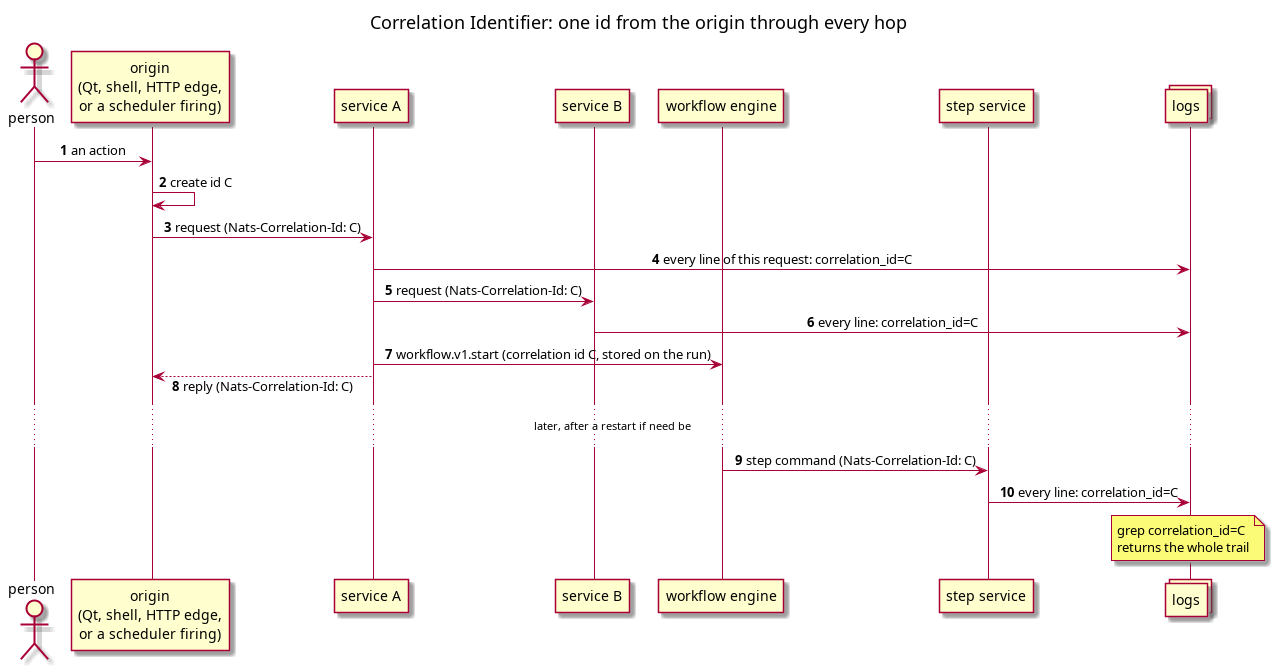
Figure 1: Correlation Identifier: the origin creates the id, every hop forwards it and logs it, and the workflow engine keeps it for steps that run later.
Source: [[./pattern_correlation_identifier.puml][pattern_correlation_identifier.puml]]. Regenerate with
plantuml -tpng doc/knowledge/service_architecture_patterns/pattern_correlation_identifier.puml.
A handler follows a fixed order on entry. It accepts a well-formed id, replaces a malformed one, creates one when none arrived, and says in the log that it did, so a broken trail is visible.
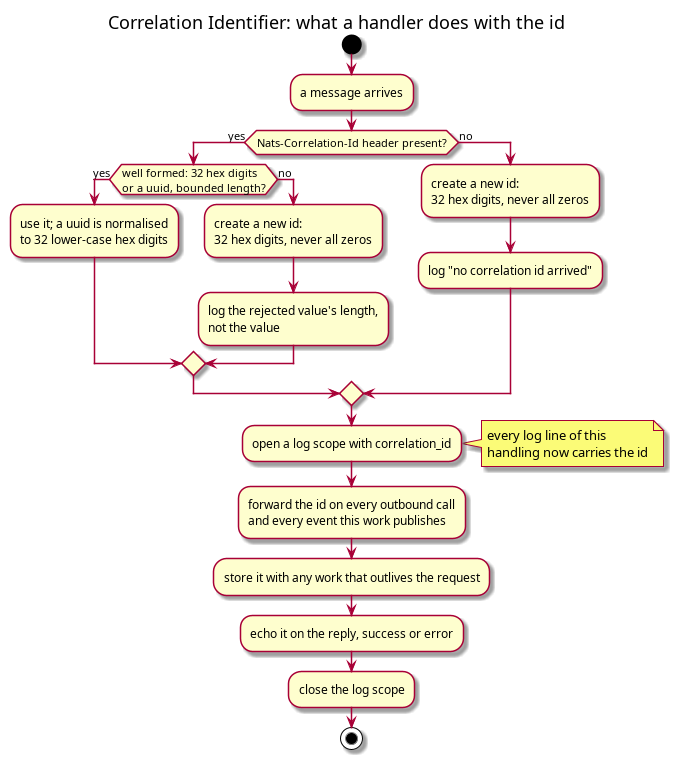
Figure 2: Correlation Identifier: what a handler does with the id, from the header check to the log scope, the forwarding and the echo.
Source: [[./pattern_correlation_identifier_handler.puml][pattern_correlation_identifier_handler.puml]]. Regenerate with
plantuml -tpng doc/knowledge/service_architecture_patterns/pattern_correlation_identifier_handler.puml.
6. Failure handling
| Concern | What the pattern does |
|---|---|
| Errors | The error reply echoes the id, and the client shows it, so a person can quote it. The error's log line names it. |
| Timeouts | A caller that times out logs the id of the request it gave up on, so the slow service's lines can be found. |
| Retries | A retry of the same request keeps the same id; a new action gets a new one. |
| Idempotency | Does not apply. The id follows work and never deduplicates it; a step keeps its own step id for that. |
| Observability | This is the pattern's purpose: one search for the id returns the trail. |
7. Pitfalls
- A hop that does not forward. The next service creates a new id, and the trail breaks there. Every hop that does not forward is a gap, and a handler that creates an id must log that it did.
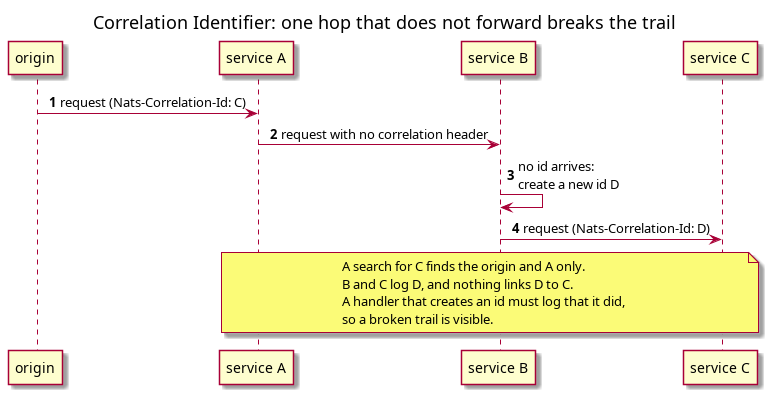
Figure 3: Correlation Identifier: service A forwards nothing, so B creates a new id and the trail from the origin stops at A.
Source: [[./pattern_correlation_identifier_broken_trail.puml][pattern_correlation_identifier_broken_trail.puml]]. Regenerate with
plantuml -tpng doc/knowledge/service_architecture_patterns/pattern_correlation_identifier_broken_trail.puml.
- The id on the entry line only. A handler that logs the id once leaves its other lines unjoined. Put the id in a log scope, so every line carries it.
- Work that outlives the request. A workflow step that runs after a restart has no inbound header unless the run stored the id. Store it with the work.
- The id used as an idempotency key. Two different requests of one action share it, so deduplicating on it drops real work.
- An outside id written to the log as it came. A value with a newline forges a log line. Accept only the expected shape.
- A session id used as a correlation id. A session spans many actions; a search for it returns all of them.
8. Security
The id grants nothing and identifies no one, so a forged id can only mislead a search. The cost of a hostile value is log injection, which the shape check prevents. The id may be stored, unlike a token, because it is not a credential.
9. Resulting context
- Benefits
- One search of the logs returns everything one action caused, across services and across time. A person can quote the id from an error.
- Liabilities
- Every hop must take part, and one that does not breaks the trail. The id shows that lines belong together, not their order in a call tree or how long each hop took.
10. In ORE Studio
- The mechanism.
ores.natsdefines theNats-Correlation-Idheader andextract_or_generate_correlation_id, andnats_client::with_correlation_idforwards it.log_handler_entryinores.servicelogs it on entry. The extractor does not yet check the shape: it accepts any non-empty value, so the log-injection pitfall below is open until the story closes it. - The workflow engine. The start message carries a correlation id, and the engine's events carry it. Report execution relies on it.
- Scheduled reports. Report execution at scale carries the firing's id through every step of a run.
- The rest of the platform. The handlers, the codegen templates, the origins and the log format do not yet carry it through. Follow a request across services from its logs is the story that does, and it states the measured starting point.
11. Related patterns
- Distributed Tracing — adds the call tree and the timings; the correlation id becomes the trace id.
- Token Relay — travels the same hops, with the same rule: forward what the inbound request carried.
- Scheduled Work Acting as a Tenant — the firing is the origin of a scheduled run, and the run id is in its token.
12. NATS patterns
The NATS service patterns hub states how each of these is written in
ores.nats code:
- Propagate the Correlation Id — the
Nats-Correlation-Idheader, generated once and forwarded by every hop. - Announce Every Handled Message — the receipt line the key is written on.
13. Sources
- Gregor Hohpe and Bobby Woolf, Enterprise Integration Patterns, Addison-Wesley, 2003, Correlation Identifier.
- Sam Newman, Building Microservices, second edition, O'Reilly, 2021, chapter 10, "From Monitoring to Observability" — correlation IDs.
- Chris Richardson, Pattern: Log aggregation and Pattern: Distributed tracing, microservices.io — the request id each log line carries.
14. See also
- Service architecture patterns — the structure note that orders this pattern language, and where to read this page in it.