Report execution
Table of Contents
This page defines the workflow Report execution. It runs one report definition to completion: it prepares the engine's input, submits it to the compute grid, records what came back, and settles the report instance. A person starts it from the shell, or the scheduler starts it from a job, and either way it leaves a completed or failed report instance and the engine's output archive in storage. The chain is a function of the definition's run configuration, so a run either executes every phase or replaces pre-processing and post-processing with prepared substitutes. A failed step marks the instance failed; a person then reads the failure on the instance and decides whether to trigger another run.
1. Purpose
Turns a report definition into a completed report instance. When it finishes, the instance has walked pending, running and completed, the engine's output archive is in storage, and the run's record says where it landed. The workflow is also what keeps reporting free of the grid's timing: submission is asynchronous, and the engine holds the run open until the compute batch closes.
2. Participants
| Participant | Kind | Responsibility |
|---|---|---|
| The caller | Actor | A person on the shell, or the scheduler firing a job. Sends the trigger and reads the answer. |
| ores.reporting (trigger handler) | Service | Resolves the definition, creates the instance, and starts the run. The only publisher of the start message. |
| ores.workflow | Service | Owns the definition and the instance, rebuilds the chain from the start message, dispatches each step, and compensates on failure. |
| ores.reporting (step handlers) | Service | Runs the reporting-owned phases: gathering, bundle assembly, input resolution, result collection and finalisation. |
| ores.ore (package handler) | Service | Packages the gathered data into the archive the engine consumes. |
| ores.compute (submit handler) | Service | Creates the compute batch and its workunits, and bridges the batch's completion back to the workflow. |
| The compute grid | Service and workers | Dispatches a workunit to a wrapper, runs the engine, and writes the output archive. |
| Storage | Service | Holds the input archive, the engine package and the output archive. |
| The client | Actor | Reads the instance and the run to render progress. |
3. Messages
| Message | Subject | Objective |
|---|---|---|
| Trigger a report instance | reporting.v1.ops.trigger_report_instance |
Carry the definition and the tenant; the reply names the instance. |
| Start the workflow | workflow.v1.ops.start_workflow |
Carry the type, the workflow instance id, and the run's request, including its run configuration. |
| Gather trades | reporting.v1.ops.gather_trades |
Select the trades the definition's scope names and store them. |
| Gather market data | reporting.v1.ops.gather_market_data |
Select the market data for the run's period and store it. |
| Assemble the bundle | reporting.v1.ops.assemble_bundle |
Persist the input bundle row that names the two stored objects. |
| Resolve the prepared input | reporting.v1.ops.resolve_prepared_input |
Answer in the packaging phase's result type with the archive the definition named. |
| Prepare the ORE package | ore.v1.ops.prepare_ore_package |
Build the tarball the engine consumes and store it. |
| Submit to the grid | compute.v1.ops.submit_compute |
Create the batch and its workunits from the tarball URIs. |
| Collect the results | reporting.v1.ops.collect_compute_results |
Ingest the engine's output for the batch. |
| Ignore the results | reporting.v1.ops.ignore_compute_results |
Record the batch and leave its output unread. |
| Finalise | reporting.v1.ops.finalise_report |
Mark the instance completed and stamp its completion time. |
| Fail the report | reporting.v1.ops.fail_report |
The compensation every step of this workflow shares: mark the instance failed with the step's error. |
The fields of each message are declared in
projects/ores.reporting/api/include/ores.reporting.api/messaging/report_operations_protocol.hpp.
4. Steps
The chain is a function of the run configuration the definition carries, so there are two shapes. A run that executes pre-processing runs seven steps; a run that substitutes it runs four. Steps 1 to 4 below appear only in the executing shape, and step 6 appears in both shapes with two possible operations.
| # | Operation | Produces | On failure |
|---|---|---|---|
| 1 | gather_trades |
A stored trades object and its key. | Compensation: the instance is marked failed. |
| 2 | gather_market_data |
A stored market data object and its key. | Compensation: the instance is marked failed. |
| 3 | assemble_bundle |
A persisted input bundle row naming both objects. | Compensation: the instance is marked failed. |
| 4 | prepare_ore_package |
The tarball URI the engine consumes. | Compensation: the instance is marked failed. |
| 4' | resolve_prepared_input |
The archive the definition named, answered in the packaging phase's own result type. | Compensation: the instance is marked failed. |
| 5 | submit_compute |
A compute batch, its workunits, and a link row the bridge watches. | Compensation: the instance is marked failed. |
| 6 | collect_compute_results |
The engine's output, ingested. | Compensation: the instance is marked failed. |
| 6' | ignore_compute_results |
The batch named, and its output left unread. | Compensation: the instance is marked failed. |
| 7 | finalise |
The instance at completed, with its completion time. | Compensation: the instance is marked failed. |
Each step's command is built from the run's request and from the earlier steps' results, which are addressed by the name of the step that produced them. A builder that cannot find or read what it consumes stops the run rather than handing the next phase an empty field.
5. Interaction
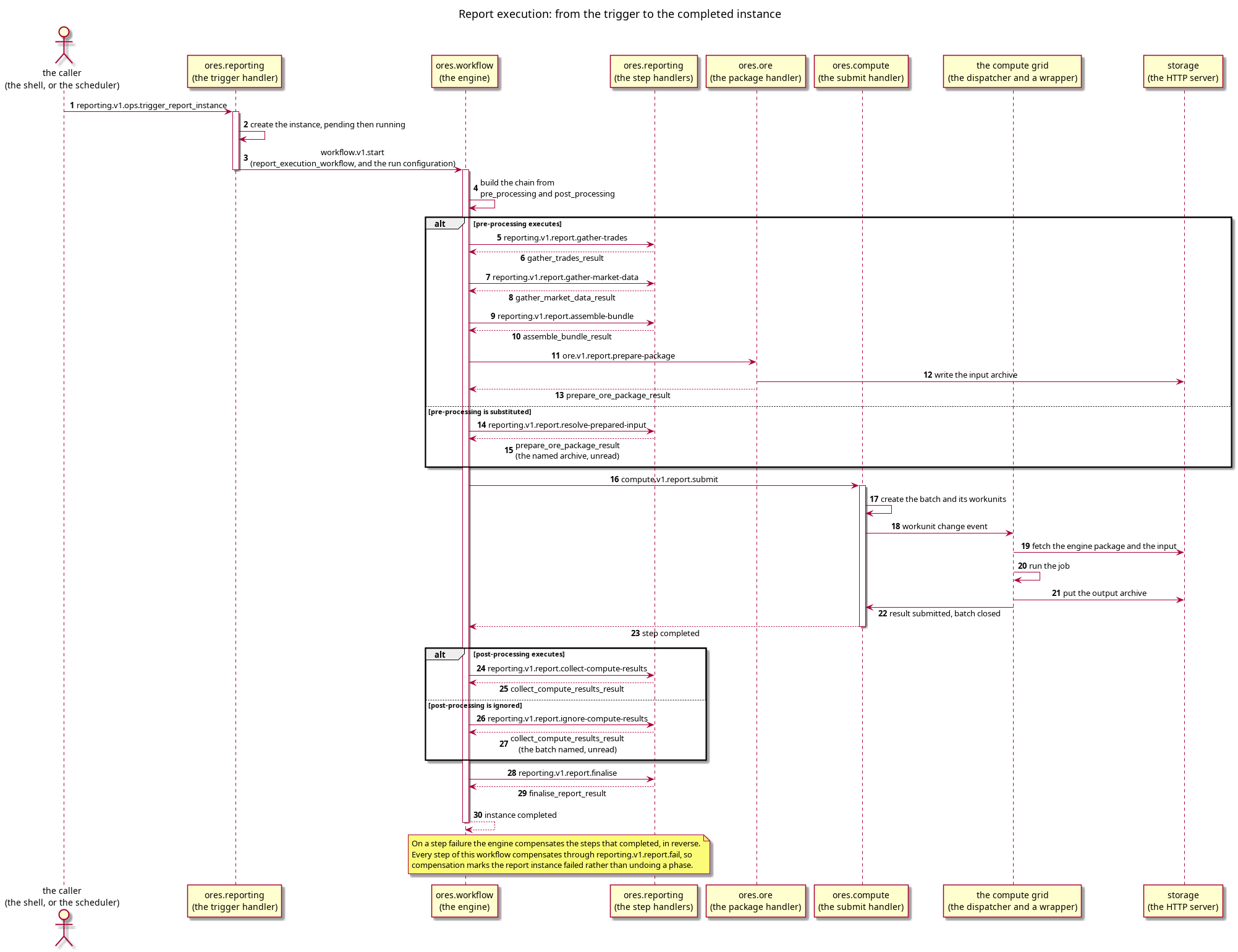
Figure 1: One run from the trigger to the completed instance, with both shapes of the chain.
Source: [[./report_execution_interaction.puml][report_execution_interaction.puml]]. Regenerate with
plantuml -tpng doc/knowledge/workflows/report_execution_interaction.puml.
6. Failure and recovery
This workflow declares no failure policy of its own: the engine compensates the
steps that completed, in reverse. Every step compensates through
reporting.v1.ops.fail_report, so a compensation is not an undo. It marks the report
instance failed with the failing step's message, and each further compensation
leaves the first message in place. What a completed step produced, a stored
object or a compute batch, stays where it is; nothing deletes it.
A retry resumes from the run's persisted record of completed steps: a restart re-dispatches every step left in progress, under its original step id. The handlers do not yet check whether they have already run, so a re-dispatched phase does work twice. Until they do, two facts follow. Treat a run that was recovered as having acted more than once, and prefer triggering a fresh run over retrying a failed one.
Two failure modes have no automatic recovery. A phase that never answers leaves
the run in progress, because there is no acknowledgement and no deadline; the run
then re-dispatches on every restart. And an unknown workflow type is logged and
dropped while the trigger has already answered triggered, so a mistyped type
looks like a successful trigger that produced nothing. Both are recorded on the
story below.
The engine's own failure rules are on Workflows.
7. Progress
Two reads render progress, and they answer different questions.
- The run:
workflow.v1.instances.listandworkflow.v1.ops.get_workflow_steps, over the workflow instance and its steps. The workflow instance id is created by the trigger and carried in the start message, so a client can follow the engine's view before the first step answers. - The report:
reporting.v1.report_instances.listandreporting.v1.report_instances.get, over the report instance. One line shows the definition, the instance's state, when it started, when it completed, and the output message.
The report instance is the read a business user follows, and it is the one that carries the failure text. Its states are pending, queued, running, completed, failed, skipped and cancelled, defined on Report definition and schedule. The engine's instance states are a separate vocabulary, and the two are not the same table.
8. Patterns used
- Correlation Identifier — the start message carries the run's correlation id.
- Saga — every step compensates
through
reporting.v1.ops.fail_report, which marks the instance failed. - Process Manager — the engine runs the report chain the run configuration selects.
9. Related
- Workflow pages — the inventory this page is listed in.
- Report execution pipeline — the phases this workflow sequences.
- Report execution orchestration — why the engine executes a run.
- Report execution substitution — the two chain shapes and what each proves.
- Report processing interfaces — every message and storage key, with its publisher and consumer.
- Sample bundle smoke test — the report that exercises the substituted chain.
- Run a full report: scheduling, reporting and compute — the story that owns the workflow.
- Run an example bundle through the compute grid from a report definition — the story that owns the known failure modes above.
10. See also
- Open Source Risk Engine — the engine the submitted package runs.