A persona may act because of its role, and no other reason
Table of Contents
1. Summary
An Acme person holds two roles: Member, which every account holds, and the one
job role the seeder gave the account when it loaded the staff. Everything the
person may do follows from those two rows and from the permissions they bundle.
No account is granted a permission directly, so the question "can this persona
decide a book change" has one answer: does its job role carry the code. That is
why adding a persona to the demonstration is two decisions and not one, and why
the seeder's role field is the only place a persona's authority is stated.
2. Detail
2.1. How the authority composes
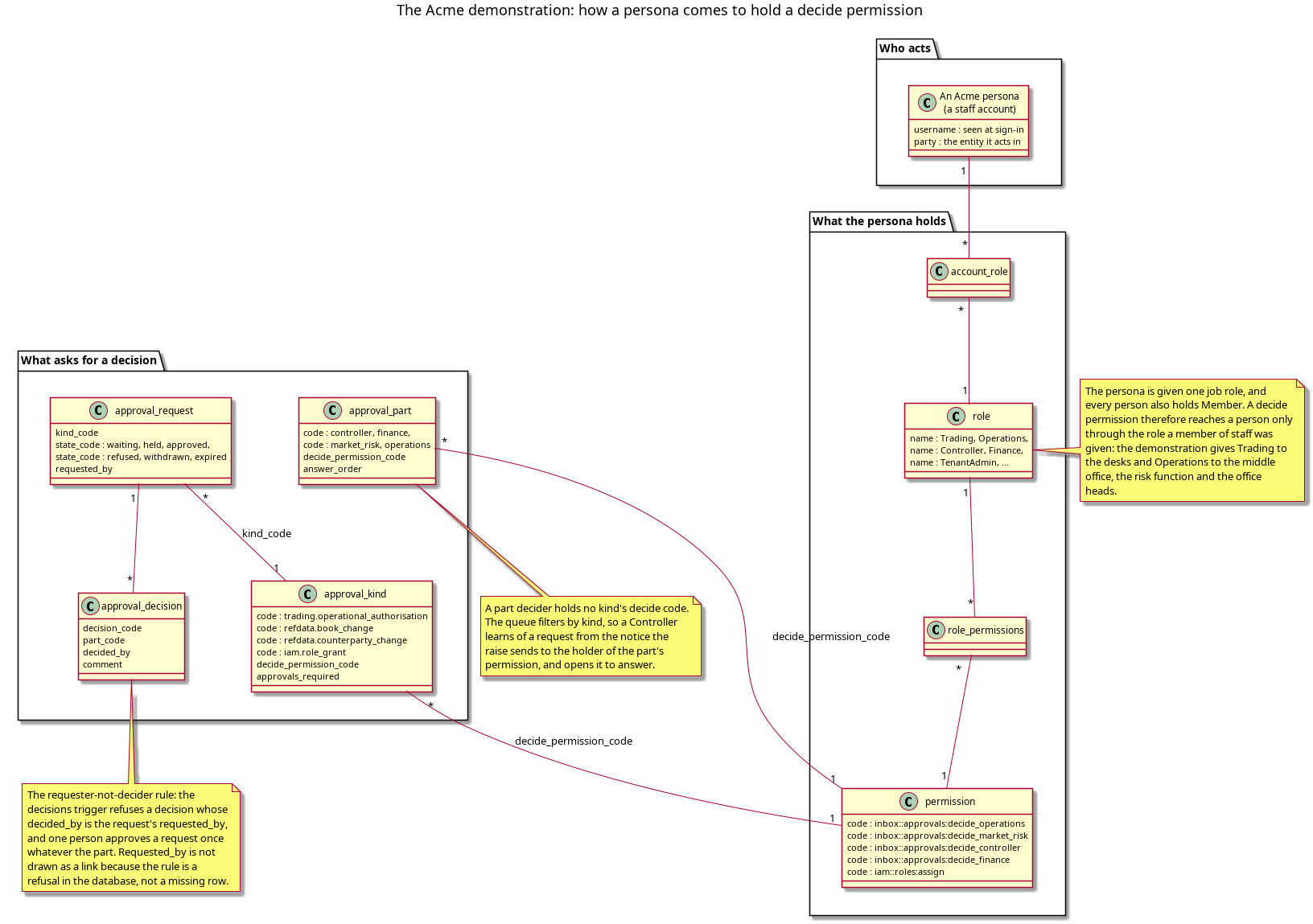
Figure 1: The Acme demonstration: a persona holds one job role and Member, a role bundles permissions, and the kinds and parts of an approval name the permission their decider must hold.
Source: acme_role_and_permission_model.puml. Regenerate with
plantuml -tpng doc/knowledge/demo/acme_role_and_permission_model.puml.
An account holds roles, a role bundles permissions, and an operation checks the
code it names. The chain has no shortcut, and the two exceptions are both
deliberate. TenantAdmin holds the single permission *, which satisfies every
check in the tenant, and a service account holds its component's wildcard, which
is why a service can write what no person may.
Role-Based Access Control
states the model, and
Identity and Access orders the pages
that carry it.
2.2. The roles the demonstration gives people
| Role | Acme personas | What the role is for |
|---|---|---|
Trading |
31 | the desks, the desk heads and the group treasurer; the people who book |
Operations |
16 | the country heads, the COOs, the heads of risk, the middle office and market risk |
Controller |
4 | the group financial controller and one head of financial control in each office |
Finance |
4 | the group finance director and one head of finance in each office |
Viewer |
12 | the analysts |
Sales |
3 | the head of sales in each office |
Support |
3 | the head of client support in each office |
Member |
74 | every account, including the tenant administrator |
TenantAdmin |
1 | the tenant administrator the provisioning creates |
Seven job roles across 73 staff, and one administrator account the profile creates outside the staff datasets. A persona holds exactly one job role, so the matrix below has one row per persona.
2.3. The matrix
| Permission | Trading | Operations | Controller | Finance | Viewer | Sales | Support | Member |
|---|---|---|---|---|---|---|---|---|
inbox::approvals:decide_operations |
yes | |||||||
inbox::approvals:decide_market_risk |
yes | |||||||
inbox::approvals:decide_controller |
yes | |||||||
inbox::approvals:decide_finance |
yes | |||||||
inbox::approval_requests:read |
yes | yes | yes | |||||
inbox::approval_requests:write |
yes | |||||||
inbox::approval_decisions:read |
yes | yes | ||||||
marketdata::subscriptions:read |
yes | yes | yes | yes | yes | |||
marketdata::subscriptions:write |
yes | |||||||
marketdata::subscriptions:delete |
yes | |||||||
marketdata::routes:read |
yes | yes | yes | yes | yes | |||
marketdata::market_data_sources:read |
yes | yes | yes | yes | yes | |||
marketdata::providers:read |
yes | yes | yes | yes | yes | |||
iam::roles:assign |
The empty cells are the point of the table, and three of them carry a decision.
Memberholds none of the inbox codes, so the approvals queue is not a screen every person sees. It is a screen for the functions that decide, and a member with no decide role reads an empty queue.- The
ControllerandFinanceroles hold nomarketdatacode. Deciding a book change does not require reading the party's market data feeds, and the demonstration keeps the two apart. - The row for
iam::roles:assignis empty for every job role. The only holder isTenantAdmin, through its*, so the decision on a role request stays with the administrator. Role requests states why that write is administrative.
2.4. The two rules that make the matrix matter
A permission is necessary and not sufficient. Two further rules sit above the codes, and both are enforced in the database rather than in a screen.
- Four eyes. A person never decides a request they raised. The decisions table refuses the row, and the queue cuts the person's own requests out of the page before it is paged, so the refusal is rarely reached.
- One decision per person. A request that needs two approvals, or several parts, takes one decision from each person whatever part they answered for, so two roles held by one account do not let it approve twice.
Approval requests states both, and the approval model applies them to the kinds the demonstration seeds.
2.5. What a persona cannot do by holding a role
Three limits are worth stating because a reader will ask.
- A job role is per tenant. A person of the Acme tenant holds an Acme role and reads nothing of another tenant, whatever the role's name.
- A role does not select a party. The demonstration gives each person a default party, and a read that is party-scoped sees that party and its children, so a controller in London decides a London book for the same reason a London trader books into it.
- A role cannot change itself. Adding a permission to a role is an IAM write, held by the administrator, and granting a role to a person is the same write.
3. What this note does not cover
Which persona decides which approval is the approval model. Who may change a market data subscription is the subscription and the route.
4. See also
- The Acme demonstration's market data and its approvals — the structure note that orders this cluster.
- Role-Based Access Control — completes: the model this page reads as a table of one tenant's people.
- Identity and Access — completes: where each layer of the chain is enforced.
- Role requests — answers: why the role-grant decision stays with the administrator.
- Approval requests — completes: the four-eyes and one-decision rules the matrix is read with.
- Know what I may do — exemplifies: the screen a persona reads this matrix through.
- Shape the role catalogue — answers: how a role's bundle of permissions is changed.
- The acme_demo seed profile — completes: the step that gives these roles to these people.
- Knowledge — the index of every knowledge hub.