ores.refdata.core
Table of Contents
1. Diagram
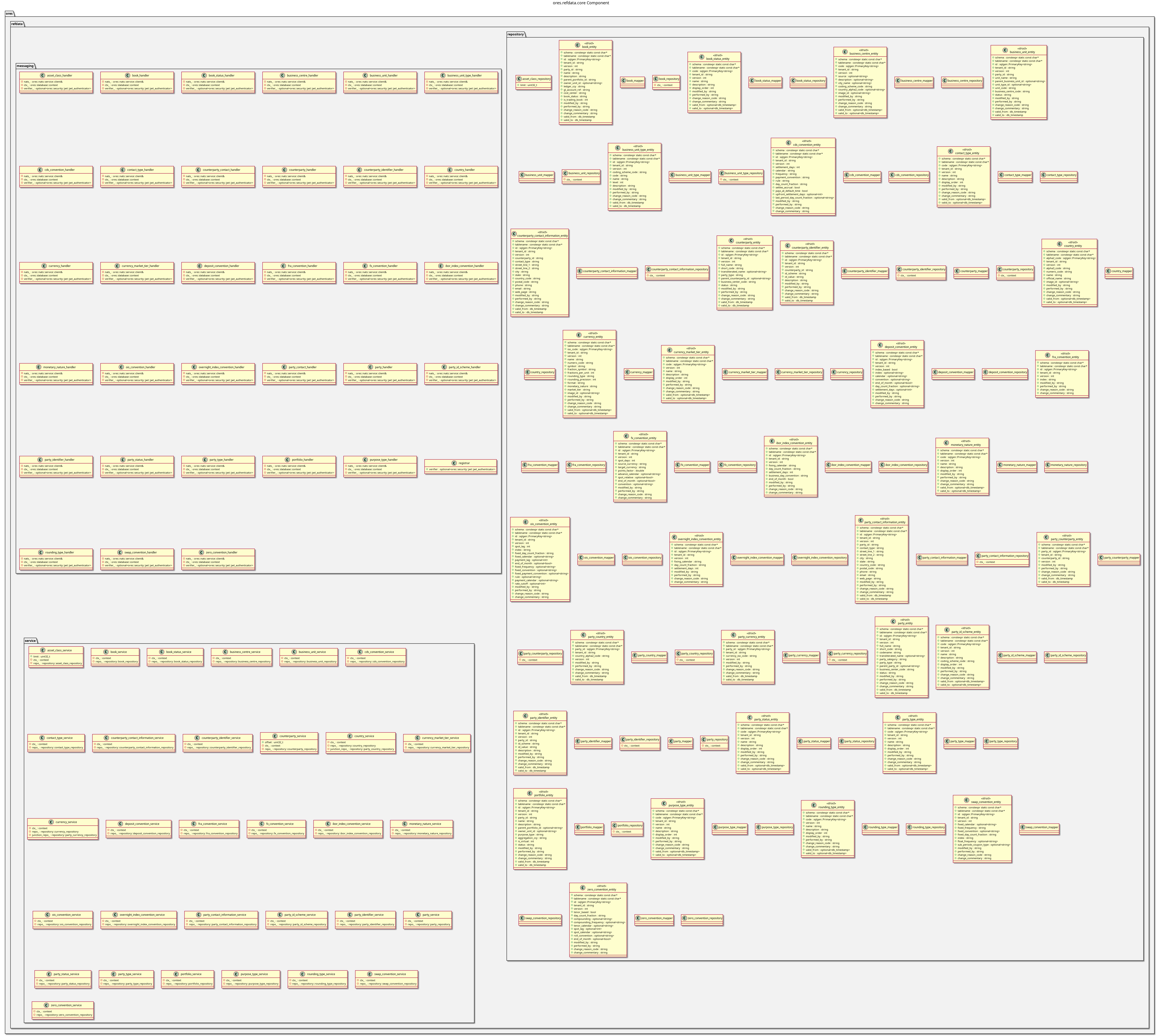
Figure 1: ores.refdata.core
2. Summary
ores.refdata.core manages the reference-data domain in ORE Studio: over 150
domain types covering currencies, countries, counterparties, books, business
units, business centres, and trading structure entities. It provides temporal
ORM repositories, domain services, NATS message handlers in the 0x3000–0x3FFF
range, CSV export for selected types, and synthetic-data generators. Reference
data is consumed by all other domain components (trading, assets, IAM) and
drives UI drop-downs and validation.
3. Inputs
- NATS request messages from UI clients and peer services (query/create/update for currencies, counterparties, books, etc.) in the 0x3000–0x3FFF range.
- PostgreSQL connections to
ores_refdata_*tables with temporal versioning. - DQ population events for bulk reference-data loads.
4. Outputs
- Reference-data records persisted to the
ores_refdataschema with full temporal history (valid_from/valid_to). - NATS response messages returned to callers.
- CSV exports of selected entity types (e.g., currencies).
5. Entry points
include/ores.refdata.core/ores.refdata.core.hpp— aggregate include.include/ores.refdata.core/messaging/registrar.hpp— registers all NATS handlers with the service host, including a currency history_provider (pilot) on ores.history.core's generichistory.v1.getsubject — seesrc/messaging/registrar.cppfor the wiring. The provider receives the same fully-scopeddatabase::context(tenant, party, roles, workspace)make_request_context()resolves for any other subject — no bespoke context threading needed.include/ores.refdata.core/service/— per-entity service headers.
6. Dependencies
ores.refdata.api— shared domain types and NATS protocol schemas.ores.dq— ORM base classes and data-quality infrastructure.ores.iam.core— identity and authorisation context.- ores.history.core — generic entity-history dispatch: registrar.cpp
registers a currency history_provider and subscribes the shared
history.v1.getsubject alongside currency's existing (still live) per-entity history subject. rfl— JSON serialisation via reflection.fort— formatted table output.soci— SQL ORM for PostgreSQL persistence.nats.c— NATS messaging client.
7. See also
- ores.refdata — component group overview.
- ores.refdata.api — protocol types and domain entities.
- ores.refdata.service — NATS service entrypoint.
- ores.refdata Messaging Reference — full NATS subject and message catalogue.
- Multi-Party Architecture — how parties, books, and business units relate.
- Trading Structure — party, book, portfolio, business-unit, business-centre hierarchy design.