ores.web
Table of Contents
1. Diagram
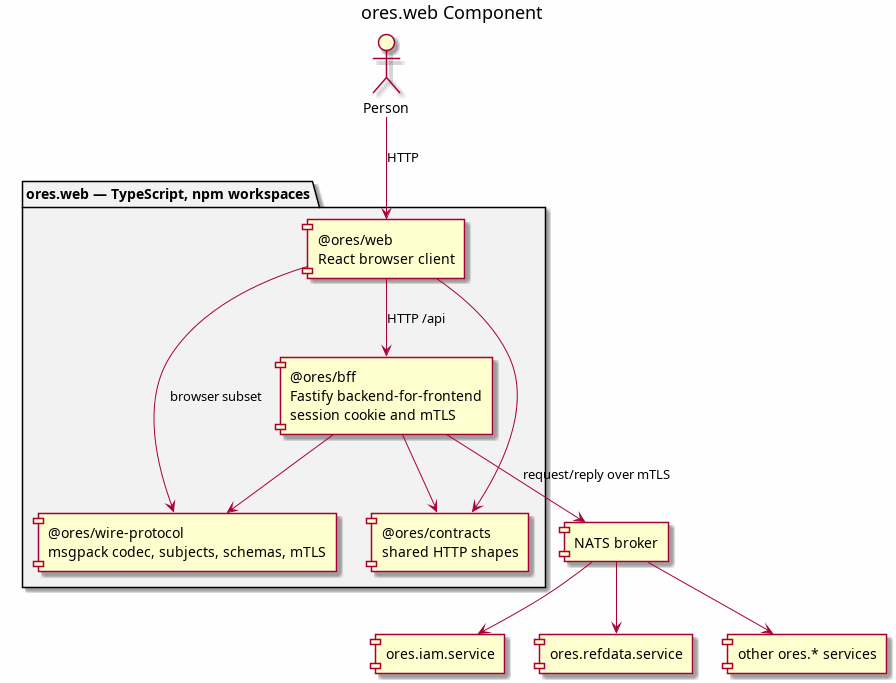
Figure 1: ores.web
2. Summary
ores.web is the browser interface for ORE Studio. It replaces the removed Qt
desktop client. A browser cannot present a NATS client certificate on a
WebSocket, so the component pairs a React client with a Fastify
backend-for-frontend (BFF) that owns the mTLS connection to the broker.
The component is a TypeScript project. It has no C++ parts and no compiled
CMake target. The four npm packages under packages/ are its structure: bff,
contracts, web, and wire-protocol. It builds with npm ci and
npm run build from the component root.
3. Inputs
- The checkout
.env, throughORES_WEB_*for the process settings andORES_NATS_*for the broker. - The site configuration in
config/environments.json, or the file named byORES_WEB_SITE_CONFIG. It declares the environments, the active environment, the developer surface, and the ACME test accounts. - NATS responses over mTLS from
ores.iam.service,ores.refdata.service, and the other domain services. - Change notifications that the services publish on their event subjects.
- The org models under
projects/ores.*/modeling/, whichores.codegenrenders into the TypeScript protocol and domain types. The generated tree is committed. - Browser requests on the
/apiHTTP surface.
4. Outputs
- The built browser bundle in
packages/web/dist. The BFF serves it onORES_WEB_PORT. - The
/apiHTTP surface on the same port. - NATS requests and subscriptions that the BFF sends on behalf of the browser.
- A first-party session cookie that holds an opaque session identifier. The token stays in the BFF, and the browser never receives it.
- Generated TypeScript in
packages/wire-protocol/src/generated/.
5. Entry points
projects/ores.web/README.md— component overview and operator instructions.projects/ores.web/packages/bff/src/main.ts— the BFF process entry point.projects/ores.web/packages/bff/src/server.ts— the Fastify HTTP surface and the static browser bundle.projects/ores.web/packages/web/src/main.tsx— the React browser entry point.projects/ores.web/package.json— the workspace scripts:build,test,typecheck,verify:login, andseed:account.
6. Dependencies
ores.iam.service— authentication, sessions, accounts, and change reasons.ores.refdata.service— reference data such as countries.- The other domain services that the browser reaches through the BFF.
ores.codegen— the generator that renders the TypeScript protocol and domain types from the org models.- Node.js 22 or later.
- Third-party libraries: Fastify, React, React Router, TanStack Query, NATS.js,
@msgpack/msgpack, Zod, Vite, Tailwind CSS, and Vitest. - The component links no C++ library, because it has no C++ parts.
7. See also
- The entity specification — a superseded specification. It required one shared list, detail and history screen per entity, driven by a generated declaration; those screens are deleted and the interface is to be built from hand-written journey screens instead.
- The component specification — the browser shell, the session, the transport to the BFF, the i18n catalogue, the styling, and the wire-protocol package.
- Change notification — the channel to the browser, the payload, and the visual language.
- Icon reference — the icon vocabulary and the process for adding to it.
- Gaps: country against the specification — a superseded audit. It measured screens and shared controls that are now deleted, and its findings cannot be reproduced.
- Qt account screen: raw reference analysis — the historical analysis of the removed Qt client.
- Protocol types are generated from the C++ codegen model — the decision behind the generated wire types.
- The connections store was removed, and why — why the per-user connection store is gone.
- ores.codegen — the generator that produces the TypeScript.
- ores.iam.service — the authentication service the browser signs in through.
- ores.refdata.service — the reference-data service the browser reaches through the BFF.
- TypeScript Clean Standard — the checklist this component's packages follow.
- Journey runtime — the journey runtime, the step-call contract, and the direction between the packages.