User Journey: Change the convention a party uses for one kind
Table of Contents
This page documents a user journey: A person changes one convention of one kind for one party, and reads what the change reaches.
A user journey describes what one person is trying to do, before anything is built. It is a design document that outlives any sprint, so it names the screens, the entity fields each screen shows, and the operations and messages each step needs.
1. Goal
"The AED swaps are being booked on 30/360 and they should be ACT/360. I want to change that one thing, and I want to know what it hits before I do it."
The person has one kind and one wrong term. The journey is done when the terms of that kind state what the person meant, they know which runs will read the new terms and which will not, and they know whether the change reached their party alone or the whole tenant.
"Choosing a different document" and "correcting a document" are the same act on this screen and different acts on the server, and the screen says which one it is about to send. Choosing a different document is picking an existing row; correcting a document is writing a new version of that row. The third act, a term no document states, is not this journey: Author a convention for a kind is.
2. Actor and trigger
The actor is the person who maintains the tenant's reference data for the desks:
an account holding Operations, which holds refdata::<kind>_conventions:read
and refdata::<kind>_conventions:write for every kind, or a tenant
administrator, who holds * and can also reach the operations no other role
holds.
The trigger is a trade or a run whose terms are wrong. The person arrives from See the conventions a party uses, having found the kind and read its terms, or from a run whose figures are doubted. The journey starts on one kind of one party and ends when the person has read the reach.
This journey writes one convention row of one kind. It does not write a report definition, its bindings or its schedule, and it does not run a report. The next run of a definition carries the change; nothing here makes one.
The journey keeps no server state. No step waits on the server after its reply.
3. Steps
- Open the kind. The person arrives with one kind and one party already chosen and lands on that kind's documents, not on the 26-kind list. The system shows the kind's name, how many term columns its table carries, how many documents the party holds, and whether the party or the tenant owns them. The scope is stated on this step and not in a footnote, because it decides who a write reaches: 22 kinds belong to the party and four belong to the tenant.
- Find the document that states the wrong term. The person filters the kind's
documents. The generated filter takes
id_one_ofand nothing else, so the field says on screen that it filters by key, and it cannot be used to ask for "the AED swaps". The screen offers the two reads that work: page the list and filter in the client, or open the document whose key the person already holds. The terms are shown in words beside each row so the person can find the wrong one by reading, which is the only search that reaches 320 documents. - Read what the row states, and what it inherits. The system opens the row.
Every term column the table carries is shown, grouped by the part of the
schedule it belongs to. A term that is a pick from another reference list
holds that list's code and never its label, and the screen shows the code and
the label and says which list owns it. A term the row leaves empty is shown
as empty and not as a value, because empty and stated are different claims.
For
deposit_conventionthe screen readsindex_basedfirst: when it is set, the row states no calendar, convention, day count or settlement days and inherits them from the index, so the person is told they are about to edit columns a run does not read. - Choose which act this is. The screen offers two, and never presents them as one button. Use a different document picks another existing row of the same kind. Correct this document writes a new version of this row with the person's terms. The person picks, and the summary states which one is staged. Nothing is written until they confirm.
- Confirm the change and see the reach before the write. The system shows what
will change: every field in the table's own order, a count of the fields that
differ from the version it read, and the reach. The reach is stated in three
sentences and each is a fact:
- It reaches every definition of this party. The conventions file a run is assembled from is written from the party's whole conventions document, and the configuration the definition binds is not read to build it. So the change reaches all 22 of ACCOUS's definitions. On a tenant-scoped kind it reaches every party of the tenant.
- The reach looks narrower than it is, and that is the danger. In ACME each party binds one conventions configuration for all of its definitions — ACCOUS 22 definitions on US conventions, ACCOUK 24 on UK conventions, ACCOHK 22 on HK conventions, ACMCOR 10 on Group conventions. So the party's reach and the configuration's reach coincide and a person never sees the difference. Where a party bound two conventions configurations the change would still reach both, and the screen would have said it reached one.
- It does not reach a run already produced. A run keeps the file it ran with, and its outputs and its errors are that run's own record.
- Nothing records which run read which version. The comparison a reader makes across the change is a comparison of two different sets of terms, and the person cannot name the runs on the far side of it.
- Write. The person saves. The system writes the row with one request,
refdata.v1.<kind>_conventions.put, carrying the change, a precondition and the intent. A correction statesmust_match_versionwith the version it read, so a concurrent edit is refused instead of overwritten; a new document statesmust_not_exist. Choosing a different document writes nothing for that reason: both documents already exist. What the person has actually staged there is a default, and there is no default to write — see What is missing. - See the result, and read what the write did not do. The system reports the document's new version, when it was written, by whom and with which change reason. It also states the two things the write did not do: it did not mark the document as the one a run takes, because no such mark exists; and it did not retire the document it replaced, because a convention is retired by a delete and this journey sends none.
- Read the versions. The person opens the history and reads every saved
version with the field-level difference from the one before. A revert is not a
history operation: it reads the old version and writes its values as a new
version, through the same
putwith a new change reason. - Leave, or go on. The person returns to the kind's list, to the conventions table, or runs the report to see the new terms take effect. The run is Run a report and watch it finish's page.
4. Screens and wireframes
One screen: the kind in the header, the documents on the left, the open document and its terms on the right, and the reach as a panel the person must read before the confirm enables. The screen writes one row and reads the rest.
The reach panel is not decoration. A person who believes they are changing one report's conventions and is in fact changing every run of the party has been misled by a screen, and this one does not do that.
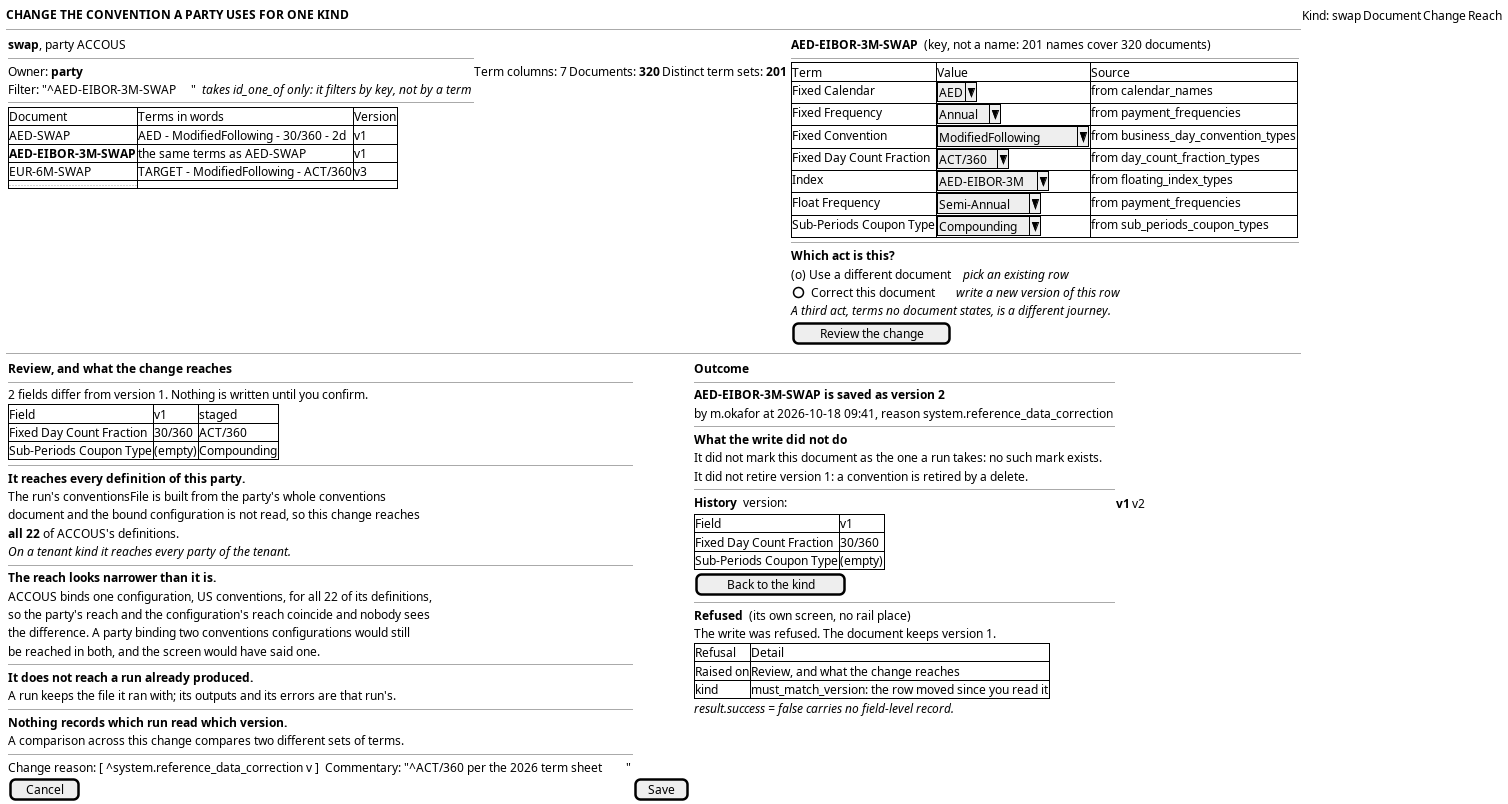
Figure 1: Change the convention a party uses for one kind: the kind's 320 documents, the open document's terms, the two acts kept apart, and the reach panel that names the 22 definitions a change reaches, why that looks narrower than it is, and the runs it does not reach.
5. Prototype
No prototype is written for this journey in this pass, and none should be until the default marker exists. The act the journey is really about, choosing which document of a kind a run takes, cannot be drawn as a working interaction when the server has nowhere to put the choice: a screen that staged one would be drawing a write that fails.
Conventions are named convention sets, and what a set holds is decided in authoring, which has its own UX and is deferred. No prototype here draws a per-kind table or a choice per kind. The decision, and the missing default marker, are recorded in the story Name the convention sets a report chooses (DE6C0BDA-D12A-4E31-AA86-C323F5A7E016). The report side of the choice is drawn in Create a report and Change what a report runs, which choose a set and never a document.
6. Entities composed
| Entity | What it contributes | Model |
|---|---|---|
| The kind's convention table | The row the journey writes: every term column of that kind, and the version the precondition names | one of the 26; see the table below |
configuration |
The conventions configuration a definition binds, whose name the reach panel reads so the person sees that the name is not a selection | ores.reporting.configuration |
report_configuration |
The binding that makes a definition a reader of these terms, counted per party | ores.reporting.report_configuration |
report_definition |
The definitions in the reach panel, and the party the export resolves | ores.reporting.report_definition |
calendar_name, day_count_fraction_type, business_day_convention_type, payment_frequency, floating_index_type |
The lists a term is a pick from; the screen shows their labels and links to the journey that owns each row |
| Kind | Rows per party | Distinct term sets | The table's own key |
|---|---|---|---|
swap_convention |
320 | 201 | id |
deposit_convention |
163 | 141 | id |
commodity_future_convention |
790 | not counted here | id |
swap_index_convention |
243 | not counted here | id |
ibor_index_convention |
10, tenant-wide | not counted here | id |
currency_pair_convention |
179, tenant-wide | not counted here | pair_code |
tenor_convention |
4, tenant-wide | not counted here | code |
The models the rest of this group leans on:
| Entity | What it contributes | Model |
|---|---|---|
swap_convention |
The worked example: seven term columns, and the row a person is most likely to be correcting | ores.refdata.swap_convention |
deposit_convention |
The row that inherits its terms from an index when index_based is set |
ores.refdata.deposit_convention |
ibor_index_convention |
The tenant kind whose row a party edit changes for every party | ores.refdata.ibor_index_convention |
overnight_index_convention |
The same, for the overnight index | ores.refdata.overnight_index_convention |
tenor_convention |
The tenant kind with a description column and no DQ route | ores.refdata.tenor_convention |
currency_pair_convention |
The tenant kind keyed by the pair rather than by an id | ores.refdata.currency_pair_convention |
party |
The owner of the 22 party kinds, and the party the export resolves | ores.refdata.party |
Every one of these tables is bitemporal. A write does not overwrite: it closes
the current row with a valid_to and writes the next version with a
valid_from, so the version a run read stays readable. The change_reason_code
and change_commentary the person supplies are stored on the row, and
modified_by and performed_by are derived from the session and not from the
request.
7. Operations and messages
| Step | Operation | Subject | Status |
|---|---|---|---|
| Open the kind | List the kind's documents | refdata.v1.<kind>_conventions.list |
exists |
| Find the document | Read one document | refdata.v1.<kind>_conventions.get |
exists |
| Find the document | Read several by key | refdata.v1.<kind>_conventions.get_many |
exists |
| Read the terms | Fill the term pickers | refdata.v1.calendar_names.list, refdata.v1.day_count_fraction_types.list, refdata.v1.business_day_convention_types.list, refdata.v1.payment_frequencies.list, refdata.v1.floating_index_types.list |
exists |
| Confirm the change | Offer the change reasons | dq.v1.change_reasons.list |
exists |
| The reach | Read the party's definitions | reporting.v1.report_definitions.list |
exists |
| The reach | Read the configurations they bind | reporting.v1.report_configurations.list |
exists |
| The reach | Read the conventions configurations | reporting.v1.configurations.list_by_configuration_type_code |
exists |
| Write | Correct the document | refdata.v1.<kind>_conventions.put (must_match_version) |
exists |
| Write | Add a document | refdata.v1.<kind>_conventions.put (must_not_exist) |
exists |
| Read the versions | List the document's versions | refdata.v1.<kind>_conventions_versions.list |
exists |
| Read the versions | Read every version with its diff | refdata.v1.history.get (entity_type = ores.refdata.<kind>_convention) |
exists |
| See the result | Learn that a convention changed | refdata.v1.<kind>_conventions_events.updated |
exists |
| Retire a document | Close a document a run should stop reading | refdata.v1.<kind>_conventions.delete |
exists, not offered by this journey |
| Choose which document a run takes | Mark one document of a kind as the one in use | (no default column, no default row) | missing |
| Search the kind by a term | Filter the list by anything but the key | (the filter is id_one_of and nothing else) |
missing |
| The screen itself | Change a convention from the browser | PUT /api/conventions/<family>, open for the deposit and swap families only |
partial |
The per-kind subjects are the generated ones: refdata.v1.swap_conventions.put,
refdata.v1.deposit_conventions.put, refdata.v1.ibor_index_conventions.put
and their equals for the rest. A tenant kind's key holds no party:
refdata.v1.ibor_index_conventions.put takes an id and no party.
The delete exists and this journey does not send it. Retiring a document a run
reads is a different decision from correcting it, and nothing checks that a
document is unreferenced before it is closed.
PUT /api/conventions/<family> exists and sends the put with
must_match_version when the body carries the version that was read. The BFF
opens it for the deposit and swap families only. No route reads one document by
its key, so the journey takes the current version from the page it read. This
journey opens the other kinds.
8. What is missing
- Choosing a different document has nothing to write to. The journey's first act, "use a different document", is the act the person most often wants, and the server has no place for it. There is no default column on any of the 26 tables and no per-kind default row keyed by tenant and kind. Choosing a different document would therefore be a write that changes nothing a run reads. A default needs one of the two shapes, and until one exists this journey cannot be built past step 4.
- The change reaches more than the screen can promise to narrow. The conventions file a run is assembled from is written from the party's whole conventions document; the bound configuration's id is not read. So a person who corrects one swap document changes what every definition of the party reads. The screen states it, and stating it does not fix it: there is no server-side way to scope the change to one report, and no server-side way to scope it to one kind's documents either, because the document write replaces the party's rows kind by kind in one call. The gap is hidden in ACME, where each party binds one conventions configuration and the two scopes coincide, so the defect is invisible until a tenant wants two.
- The list cannot be searched by a term. The generated filter accepts
id_one_ofand nothing else. On a kind of 320 documents, a person who knows the term and not the key cannot find the row. A term filter on each list is the missing operation, and it is the same gap See the conventions a party uses records. - No operation says whether a document is in use. Nothing joins a convention row to a run, a trade or a definition, so the screen cannot warn that the document about to be corrected is one something reads. The best it can do is say that every document of the party is read by every run.
- A refused write carries no field-level record. The refusal this journey must
handle is a term that references a value its list no longer holds, and the
generated
resultcarries nofield_failurefor a convention service, so the server cannot name the field it refused and the screen must match the code and the message itself. - No convention field validates its term. A convention's term columns are plain text with no foreign key and no lookup check declared on the model, so the server stores any text. A term that references a value the list does not hold is written rather than refused, and the run is where it shows up.
- A tenant-scoped kind is changed for the whole tenant with no warning. Four
kinds carry no
party_id:currency_pair,ibor_index,overnight_indexandtenor. A person correcting the IBOR index conventions for their own party is changing 10 rows the whole tenant reads. The screen can say so because the table's shape says so; nothing in the server reports the scope back, and the write is refused by no one. - The whole-document write is a second, wider write to the same rows.
refdata.v1.conventions_documents.putwrites every kind of the party's document in one call, and it leaves rows it is not given alone, so it can neither delete nor retire. A person holdingTenantAdmincan therefore send a document that changes many kinds at once and receives no warning and no summary of what moved. The per-kindputis the narrower act and is the one this journey sends; the wider one existing beside it is the hazard. - No four-eyes control is seeded for a convention change. The approval operations exist, and no request kind is seeded for a convention row, a request holds no pending change, and nothing applies the change when the last decider approves. A person changing a term every desk reads cannot be second-checked today.
- No run records the version of a convention it read. The history view says what changed and not which run was affected, so the reach panel's third sentence is a gap and not a warning.
9. Related journeys
- See the conventions a party uses — the read this journey starts from, and the table a person arrives holding a kind from
- Author a convention for a kind — the same kind, when no document states the terms at all
- Publish conventions from data quality — the same rows arriving from the curated dataset, which is how the other 25 kinds are maintained
- Maintain a classification list — a term that is a pick is corrected on the list that owns it and not on the convention
- Add or correct a currency — a cross-currency or an FX convention names the currencies whose pair it serves
- Set up a currency pair — the currency-pair convention is 1:1 with its pair and edited from either side
- Run a report and watch it finish — the run whose next firing carries the change
- Look back over a report's history — the runs the change makes incomparable
10. Related knowledge
- Conventions journeys — the group this journey belongs to
- Reference Data — versioning, provenance, change reasons and the precondition
- ORE Model Configuration — the ORE
conventions.xmlelements these rows export to - UX Language — the badge and form vocabulary the terms panel follows
- Reporting journeys — the runs that read these terms
- Journey execution — how the screen composes its reads
- User Journeys — the index
11. See also
- User Journey Extraction Standard — the checklist this journey is written against
- Document type: user_journey — the eleven sections this page fills
conventions_bundle_service::apply— the wider write that replaces the party's rows kind by kindore.v1.ops.export_run_configuration— the export that reads the party's document and ignores the bound configuration