User Journey: Publish conventions from data quality
Table of Contents
This page documents a user journey: A data quality operator publishes the curated conventions dataset into a tenant and reads what landed.
A user journey describes what one person is trying to do, before anything is built. It is a design document that outlives any sprint, so it names the screens, the entity fields each screen shows, and the operations and messages each step needs.
1. Goal
"The curated ORE conventions are the ones we trade on. I need them in the tenant, for the party that trades, and I need to know what arrived, what did not, and what a second publish will do before I run it."
This journey is how every convention a party holds actually arrives. ACME holds 10,991 convention rows across 26 kinds, and 25 of those kinds came from a DQ publish. The person is not authoring a term and not choosing one: they are moving a curated catalogue into a tenant and reading the receipt.
The journey is done when the person can state four things: which kinds the publish covers, how many rows each kind landed with, why part of the receipt is a skip rather than an insert, and what a re-publish would and would not change.
2. Actor and trigger
The actor is a data quality operator or a tenant administrator. Publishing a dataset is a DQ permission and reading what it wrote is a reference data permission; in a small tenant one person holds both. A data quality operator arrives with a dataset that has been curated or corrected. A tenant administrator arrives because a party has been added or because a term in the tenant is stale.
The trigger is three different things and the same journey covers all three: a new tenant or party that needs the curated set, a curated row that has been corrected upstream and should now be in the tenant, and a publish that returned a skip count nobody can explain. The journey starts at the dataset and ends when the person has read the counts against what they expected.
The journey writes through the DQ publish path and sends no per-kind convention write. It does not author a term, does not choose which document a run takes, and does not run a report.
The journey keeps no server state of its own. The publish does: it runs as a workflow instance, and progress is read from the instance and not from the client.
3. Steps
Read the dataset. The person opens the dataset and reads what it is. There are two for conventions:
ore.conventions, named ORE Instrument Conventions, artefact typeconventions, catalogue ORE Analytics, subject area Trading, domain Reference Data;refdata.currency_pair_conventions, named Standard Currency Pair Conventions, artefact typecurrency_pair_conventions, catalogue FX Market Conventions, subject area Currency Pairs.
The person also reads the third,
refdata.currency_pair_convention_calendars, which carries the calendars a currency pair advances on, because a pair without its calendars is half a convention.- Read what each dataset covers, and count the kinds. The first dataset's
artefact type names 24 artefact tables and one subject,
refdata.v1.ops.publish_conventions_from_dq. The function behind it loops an array of exactly those 24 kinds and dispatchesores_dq_<kind>_conventions_artefact_tblintoores_refdata_<kind>_conventions_tbl. The second dataset coverscurrency_pairalone, on its own subject. Together that is 25 kinds of the 26. The person is shown the 26th explicitly, because a publish that silently covers 25 of 26 is a trap:tenorhas no DQ route at all. There is noores_dq_tenor_conventions_artefact_tbl, so no function can copy it, and its 4 rows are not published — they are copied from the system tenant when the tenant is created. The screen says so on thetenorrow rather than leaving the count to be discovered. - Read the bundle that carries it, and who it publishes for. The two datasets
travel in different bundles, and the difference decides who they land for.
ore.conventionsis a member ofparty_essentials, which is published once per party with a{"party_id": "..."}parameter.refdata.currency_pair_conventionsand its calendars are members ofbase, which is published once per tenant. The person reads this before publishing, because "publish the conventions" means one thing per party and another per tenant, and a person who publishesbaseexpecting party rows gets none. - Publish. The person publishes. The operation is
dq.v1.ops.publish_bundle, which the shell spellsbundles publish <bundle> --party-id <id> --wait. The service starts a workflow instance and the publication walks the bundle's datasets in dependency order, one step per dataset. The conventions step is one step of that run and not a run of its own. With--waitthe person watches step transitions and the command returns when the instance reaches a terminal state. Without it they hold an instance id and read progress fromworkflow.v1.ops.get_workflow_steps. Read the counts the publish returns. The step's result is four counts:
records_inserted,records_updated,records_skippedandrecords_deleted. ACME's actual receipts, in publish order:- the first party: 2,188 inserted, 0 skipped, 0 updated;
- each of the next four parties: 2,155 inserted, 33 skipped, 0 updated;
- a later re-publish of the same party: 0 inserted, 2,188 skipped, 0 updated.
The person reads all three against each other, because the difference between them is the whole of this journey's remaining steps.
- Explain the 33. 2,188 is 2,155 plus 33, and the 33 is not a defect. Four of
the 26 kinds are tenant-scoped — their table carries no
party_idcolumn — and two of them are in the 24-kind array:ibor_indexwith 10 rows andovernight_indexwith 23. 10 + 23 = 33. The publish's insert is guarded by "this key does not exist for this tenant and party", and for a table with no party column that guard finds the row the first party's publish wrote. So the first party's publish writes them and every later party's publish reports them as skipped, because they are not that party's rows to write. The person reads the 33 as already present, tenant-wide, and not as a failure. The screen states the arithmetic and names the two kinds, because a skip count of 33 with no account of it is unreadable. - Explain what a re-publish will and will not do, before running it. This is
the step the journey exists for. The 24-kind function writes with an insert
guarded by "the row is not already there", and it has no update path: its
result carries no
updatedcount and the function's own body never updates a row. So a curated row corrected in the dataset does not reach a tenant that already holds it — the re-publish reports it as skipped and the tenant keeps the old terms. A re-publish of a party that already has its rows is 2,188 skipped and 0 inserted. The exception iscurrency_pair: its own function inserts with the store's version-replace, and its second publish reports 179 updated. So 25 of the 26 kinds cannot take a correction and 1 can, and the person is told which is which on the row rather than from a run's surprise. Correcting a convention a tenant already holds is Change the convention a party uses for one kind's job, done per row. - Read what the publish cannot show. The person asks what the curated rows
actually say before publishing them. Nothing answers. There is no read of an
ores_dq_*_artefact_tblover NATS: DQ publishes artefact types and datasets, and the rows they stage are readable only in the database. So the person can read what landed in the tenant, kind by kind, and cannot read what is about to land. The screen says so and does not draw an artefact preview it cannot fill. - Read where the
tenorrows came from, and when. The fourtenorrows were copied from the system tenant when the tenant was provisioned, byores_iam_provision_tenant_fn, withchange_reason_codesystem.new_recordand the commentary "Copied from the system tenant during provisioning". That copy happens once per tenant and never again. A change to the system tenant's tenor conventions reaches a new tenant and does not reach an existing one, and no publish refreshes it. The row says so. - Leave, or go on. The person has the receipt. They either go to the party's conventions to verify what a run will read (See the conventions a party uses), or to a kind to correct a term the publish could not carry (Change the convention a party uses for one kind).
4. Screens and wireframes
One screen: the dataset in the header, the kinds it covers with their counts, the bundle and the scope it publishes for, the publish action with its instance, and the receipt. The receipt is the largest panel, because the counts are the answer and the same four counts mean different things on the first publish, the fourth and a re-publish. The screen shows the last publish's counts beside what the person expected, so a skip count is read against an expectation rather than in isolation.
The screen never shows artefact rows. There is no operation that returns them, and a panel that drew an empty table would be claiming a read that does not exist.
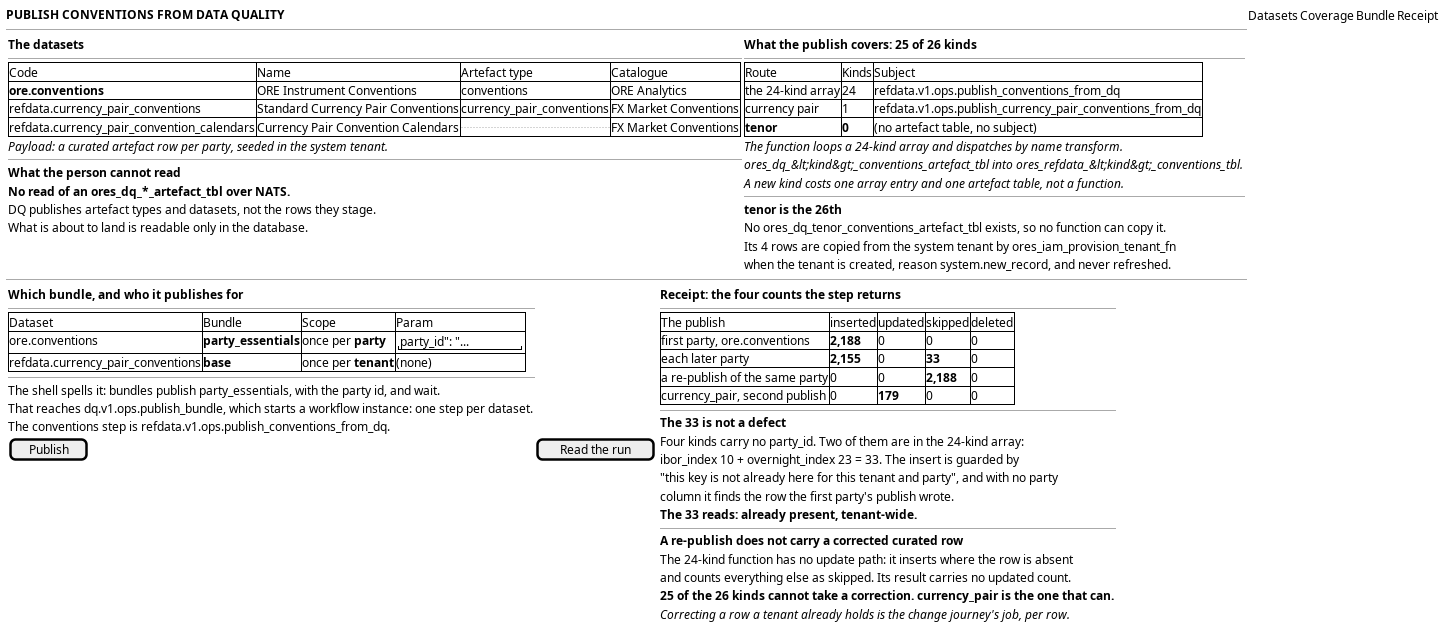
Figure 1: Publish conventions from data quality: the two datasets with the 25 of 26 kinds they cover, the tenor exception, the bundle and scope per dataset, and the receipt as it reads on the first party, a later party, and a re-publish.
5. Prototype
No prototype is written for this journey in this pass, and none should be until the artefact read exists. The screen's central panel is a receipt the person compares against an expectation, and half the expectation — what the curated rows say — cannot be read at all. A prototype would have to fake the half that matters.
What a prototype must draw when the read exists is stated here so it is not lost:
the four counts, in three columns, one per publish act; the 33 accounted for by
the two tenant kinds; the tenor row marked as not published; and the one kind
that updates marked apart from the 25 that do not.
6. Entities composed
| Entity | What it contributes | Model |
|---|---|---|
dataset |
The two convention datasets, their names, their artefact types and their catalogue | |
artefact_type |
What each dataset stages and publishes as, and the subject that carries it | |
dataset_bundle, dataset_bundle_member |
The bundle each dataset travels in, and therefore whether it publishes per tenant or per party | |
| The 26 convention tables | Where the rows land. 22 carry party_id and are written per party; four carry none and are written once per tenant. |
one per kind; see below |
change_reason |
system.external_data_import for a published row and system.new_record for a copied one, which is how a row states its own provenance |
|
party |
The party a party_essentials publish writes for |
ores.refdata.party |
| Kind | Route | Rows per party | Rows per tenant | Re-publish behaviour |
|---|---|---|---|---|
| the 22 party kinds | refdata.v1.ops.publish_conventions_from_dq |
2,155 | — | insert only; a correction is skipped |
currency_pair |
refdata.v1.ops.publish_currency_pair_conventions_from_dq |
— | 179 | version replace; a correction is written as an update |
ibor_index |
the 24-kind subject | — | 10 | skipped after the first party, because it has no party column |
overnight_index |
the 24-kind subject | — | 23 | skipped after the first party, for the same reason |
tenor |
none | — | 4 | copied at tenant provisioning, never republished |
The models the rows land in:
| Entity | What it contributes | Model |
|---|---|---|
swap_convention |
The worked example of a party kind: 320 rows per party from 320 staged rows | ores.refdata.swap_convention |
deposit_convention |
The contrast, 163 rows per party | ores.refdata.deposit_convention |
ibor_index_convention |
One of the two tenant kinds in the 24-kind array, and part of the 33 | ores.refdata.ibor_index_convention |
overnight_index_convention |
The other one, and the larger part of the 33 | ores.refdata.overnight_index_convention |
tenor_convention |
The kind with no DQ route | ores.refdata.tenor_convention |
currency_pair_convention |
The kind with its own subject and its own bundle | ores.refdata.currency_pair_convention |
The publish copies the live table's own data columns, read from
information_schema at call time, less the columns it stamps. That is why one
function spans 24 kinds: a new kind costs one array entry and one artefact table,
not a function. It also means the published row's key is the artefact's key, so
a curated document keeps one key across every tenant that publishes it.
7. Operations and messages
| Step | Operation | Subject | Status |
|---|---|---|---|
| Read the dataset | List the datasets | dq.v1.datasets.list |
exists |
| Read the dataset | Read one dataset | dq.v1.datasets.get |
exists |
| Read the dataset | Read the artefact types | dq.v1.artefact_types.list |
exists |
| Read the bundle | List the bundles | dq.v1.dataset_bundles.list |
exists |
| Read the bundle | Read a bundle's members | dq.v1.dataset_bundle_members.list |
exists |
| Publish | Publish a bundle | dq.v1.ops.publish_bundle |
exists |
| Publish | Publish one dataset | dq.v1.ops.publish_datasets |
exists |
| Publish | Watch the run's steps | workflow.v1.ops.get_workflow_steps |
exists |
| Publish | List the instances | workflow.v1.instances.list |
exists |
| Read the receipt | The counts the publish returns | the step's result_json: records_inserted, records_updated, records_skipped, records_deleted |
partial |
| Read the receipt | List the tenant's published conventions | refdata.v1.<kind>_conventions.list |
exists |
| Read the receipt | Read the party's whole conventions document | refdata.v1.conventions_documents.get |
exists, not reachable by a person |
| Read what is about to land | Read an artefact table's rows | (no read of ores_dq_*_artefact_tbl over NATS) |
missing |
| Read the receipt | Read one publish's counts and its whole receipt | (no read of a publication's result; the counts are on the workflow step) | missing |
| Read the receipt | Attribute a skip count to a kind | (the function returns one total, not a breakdown) | missing |
The publish steps that the function serves are subscribed by the reference data
service's publish_from_dq_handler, one handler for every
publish_*_from_dq subject, and each call reaches a security definer SQL
function. The counts reach the caller through the workflow step's result and not
through a service read of the tenant's own tables.
No BFF route serves DQ. This journey adds one, for example
GET /api/dq/datasets/<code>/conventions, which returns the kinds the dataset
covers, the artefact suite count, the bundle and the scope, and the last
publication's counts per kind. That read has to be built on a per-kind count and
does not exist today.
8. What is missing
- A corrected curated row never reaches a tenant that already holds it. The
24-kind publish function has no update path: it inserts where the row is
absent and counts everything else as skipped. Its result type carries no
updatedcount, and its body performs no update. A re-publish after a correction returns 2,188 skipped and 0 inserted, and the tenant keeps the old terms. This is the most consequential gap in the group: the curated dataset is the source of truth for 25 kinds and it cannot be corrected downstream.currency_pairis the only kind whose function replaces the row it finds. - A skip count is a total, not an account. The function returns one
records_skippedfor the whole 24-kind loop. The person who sees 33 cannot learn from the server that 10 areibor_indexand 23 areovernight_index. The arithmetic is derivable by counting the tenant-scoped kinds' rows, and the server does not state it. - Nothing reads the curated rows. No operation returns an
ores_dq_*_artefact_tblrow. DQ exposes artefact types and datasets and not the rows they stage, so a person can read what landed in a tenant and cannot read what is about to land. Comparing a curated document against the tenant's copy is a database query and not a screen. - No read states a publication's outcome. The counts exist on the workflow
step's
result_json, and no operation returns a publication with its counts and the dataset it published. A person reads a workflow instance to learn what a dataset did. - `tenor` has no publish route at all. There is no
ores_dq_tenor_conventions_artefact_tbland no subject. Its 4 rows come from a one-time copy at tenant provisioning, so a corrected tenor convention reaches only tenants created after the correction. A DQ artefact table and a subject would close it, and until then this is the one kind whose curation cannot be shipped. - A tenant-scoped kind publishes once and is then reported as skipped forever.
ibor_indexandovernight_indexare in the 24-kind array and their tables carry noparty_id, so the insert's "already present" guard fires for every party after the first. The behaviour is correct and the receipt is not: a person publishing a party is told 33 rows were skipped without being told that they are present, tenant-wide, and were written for someone else. - A tenant-scoped kind cannot be published per party even if a tenant wanted
it.
currency_pair's function writes the whole tenant, andcurrency_pairis inbase, a tenant bundle. There is no way to give one party a different pair convention, which is consistent with the 1:1 pair model and is a limit a reader should be told rather than discover. - The publish cannot be scoped to a kind. One subject publishes 24 kinds together. A person who needs one kind refreshed cannot ask for it, and a failed step is a failed publish of all 24. There is no per-kind publish subject, and the function's array is the only partition.
- No dry run. The mode is
upsert,insert_onlyorreplace_all, and there is no mode that reports what it would do. On a function that skips rather than updates, a dry run is the only way to learn what a publish would change, and there is not one. - `replace_all` is offered and closes rows before it writes. The 24-kind
function does not honour
replace_allat all — it ignores the mode and its contract says the mode has no effect — whilecurrency_pair's function does honour it and closes every current pair convention in the tenant before inserting. A caller reading "all publish functions take the same modes" would be wrong here, and a person who sendsreplace_allto the currency pair function removes what the dataset no longer carries.
9. Related journeys
- Onboard a party and verify its conventions — the publish as it lands for a newly provisioned party, and how a person checks it
- See the conventions a party uses — what a run reads after the publish has landed
- Change the convention a party uses for one kind — how a correction reaches a tenant that already holds the row
- Author a convention for a kind — a term the curated dataset does not carry, written in the tenant and not published back
- See the reports a party runs — the runs that read what this publish wrote
10. Related knowledge
- Conventions journeys — the group this journey belongs to
- DQ artefacts — the artefact table, the dataset, the artefact type, the bundle and the publish contract this journey follows
- Provisioning operations and the plan — the bundle a starting point publishes and the scope it publishes for
- Reference Data — provenance, change reasons and the bitemporal store
- ORE Model Configuration — the ORE
conventions.xmlelements the published rows export to - User Journeys — the index
11. See also
- User Journey Extraction Standard — the checklist this journey is written against
- Document type: user_journey — the eleven sections this page fills
ores_refdata_publish_conventions_from_dq_fn— the 24-kind function, its array and its insert-only guardores_refdata_publish_currency_pair_conventions_from_dq_fn— the one function that replaces the row it findsores_iam_provision_tenant_fn— the one-time copy of the tenor conventionsbundles publish <code> --party-id <id> --wait— the shell spelling ofdq.v1.ops.publish_bundle