User Journey: Onboard a party and verify its conventions
Table of Contents
This page documents a user journey: A tenant administrator verifies that a newly provisioned party has the conventions its runs will read.
A user journey describes what one person is trying to do, before anything is built. It is a design document that outlives any sprint, so it names the screens, the entity fields each screen shows, and the operations and messages each step needs.
1. Goal
"I have just provisioned a party. Its runs need market terms from the first minute. Do they have them, and how would I know if they did not?"
This journey is a verification and not a fill. A party's conventions are not
something a person assembles: the provisioning run publishes the
party_essentials bundle once per party, and that bundle's first member is the
conventions dataset. So the correct answer to "how do I give the new party its
conventions" is "you do not — the run did it". The journey exists because a
person still needs to prove it, and because the one state that goes wrong here
goes wrong silently.
The journey is done when the person can state, for the party they just created, how many documents of each kind it holds, which of those belong to the tenant rather than the party, and what a run of that party would write today.
2. Actor and trigger
The actor is a tenant administrator, or the person operating provisioning for
the tenant. They hold the tenant's permissions in full and they act inside their
own tenant. The trigger is a party that has just been created — by a starting
point's provision_party operation, by the Acme demo profile, or by an
administrator creating one outside a plan — and a run that either has not been
made yet or has produced figures nobody has checked.
The journey starts when the party exists and ends when the person has read its conventions back, or has found that it has none and knows what would fill them.
This is a verification journey. In the normal case it writes nothing: the party provisioning already wrote the rows. It reaches one write only in the abnormal case, and only by handing the work to Publish conventions from data quality, which is the same publish the provisioning run made.
The journey keeps no server state. The provisioning run does: it is a workflow instance, and its steps are where the person reads what the run actually did.
3. Steps
- Read that the conventions are part of provisioning, and not a step after it.
The person opens the provisioning run and reads the party plan's step 30,
provision_party, whose argument is{"bundles": ["party_essentials"]}. The bundle states what it carries: "The reference data a single party needs: its instrument conventions and its CRM topology. Published once per party with a{"party_id": "..."}param." The person reads that the conventions and the CRM topology are the same operation, and that neither is a manual fill. In the Acme demo profile the four operational parties reach this step through the same plan, after the LEI hierarchy import and before staff are loaded. - Read the publish the plan's step performs, and in what order. The bundle
publishes its members in dependency order, one workflow step per dataset. The
conventions dataset,
ore.conventions, is the bundle's member at display order 5, before the CRM topology at 20. The step's command subject isrefdata.v1.ops.publish_conventions_from_dqand its parameters carry the party's id. The person reads the step's counts, not a summary: the first party's publish writes 2,188 rows, and every later party's publish writes 2,155 and skips 33. - Read the 33 as already-present and not as a failure. 2,188 is 2,155 plus 33.
The 33 are the tenant-scoped kinds that the first party's publish wrote:
ibor_indexwith 10 andovernight_indexwith 23. They carry noparty_id, so they are the tenant's rows and every later party's publish correctly finds them present. A person who reads 33 without this account reads a defect. The screen states the two kinds and the two counts beside the skip. - Read the party's own total against what it should be. The person reads the
party's conventions back, kind by kind. A party published from the bundle
holds 2,155 rows across the 22 party kinds, and reads a further 216 across the
four tenant kinds —
currency_pair179,overnight_index23,ibor_index10 andtenor4 — which belong to the tenant and are shared with every other party. So the party's own count and the number of documents a run of that party reads are different numbers, and the screen shows both. Read why the tenant kinds were there before the party was. Of the four, two arrived differently from the rest and the person reads why.
currency_pairis published into the tenant by thebasebundle, which is a tenant publication and not a party one, so its 179 rows exist before any party is provisioned.tenor's 4 rows are not published at all. They are copied from the system tenant byores_iam_provision_tenant_fnwhen the tenant is created, withsystem.new_recordand the commentary "Copied from the system tenant during provisioning", and they are never refreshed afterwards.
The screen states which of the four came from where, because "the run did it" is true of 2,155 of the rows and of none of the 33's second and later parties.
- Read what a run of this party would write today. The person asks the
question the party was provisioned to answer: what file does a run of this
party carry? The export reads the party's whole conventions document, kind by
kind, and writes it as the run's
conventionsFile. For a party published from the bundle that file holds the party's 2,155 rows and the tenant's 216. The person reads that the four conventions configurations ACME's definitions bind do not enter into it, and that every definition of the party writes the same file. - Read the one party that has nothing, and what that means. The person creates
a party outside the plan, or reads a party whose
provision_partystep failed. It holds nothing for the 22 party kinds, because the bundle's publish never ran for it. It still reads the tenant's 216 for the four tenant kinds, so the party is not empty and the emptiness is easy to miss. Its runs write aconventionsFilewith no rows for 22 kinds. Nothing in the tree refuses such a run and nothing says the party was skipped. This is the state the journey exists to catch, and the screen marks it plainly rather than drawing an empty table with no explanation. - Fill the gap with the operation provisioning already used, not with a
hand-written set. The person who has to fix a party nobody published for
sends the same publish provisioning sends:
dq.v1.ops.publish_bundleforparty_essentialswith the party's id, or the dataset alone withdq.v1.ops.publish_datasets. That publish writes the 2,155 rows and reads the 33 as skips, exactly as it does inside provisioning. The person does not author 2,155 rows and does not choose documents: Publish conventions from data quality owns that act and this journey hands to it. - Leave, or go on. The party is verified. The person either reads its conventions in detail (See the conventions a party uses), or corrects a term the party needs differently from the curated set (Change the convention a party uses for one kind).
4. Screens and wireframes
One screen: the party and the provisioning run in the header, the publish step with its four counts, and the per-kind read of what the party holds and what it shares with the tenant. The state that matters is drawn once and drawn plainly: a party with no party-scoped conventions is marked as unpublished, with what a run would write and which operation would fill it.
The screen does not offer a hand-entry path for the 2,155 rows. A screen that offered one would be teaching a person to do by hand what the plan does, which is how a party ends up with 2,155 rows that match no dataset and no provenance.
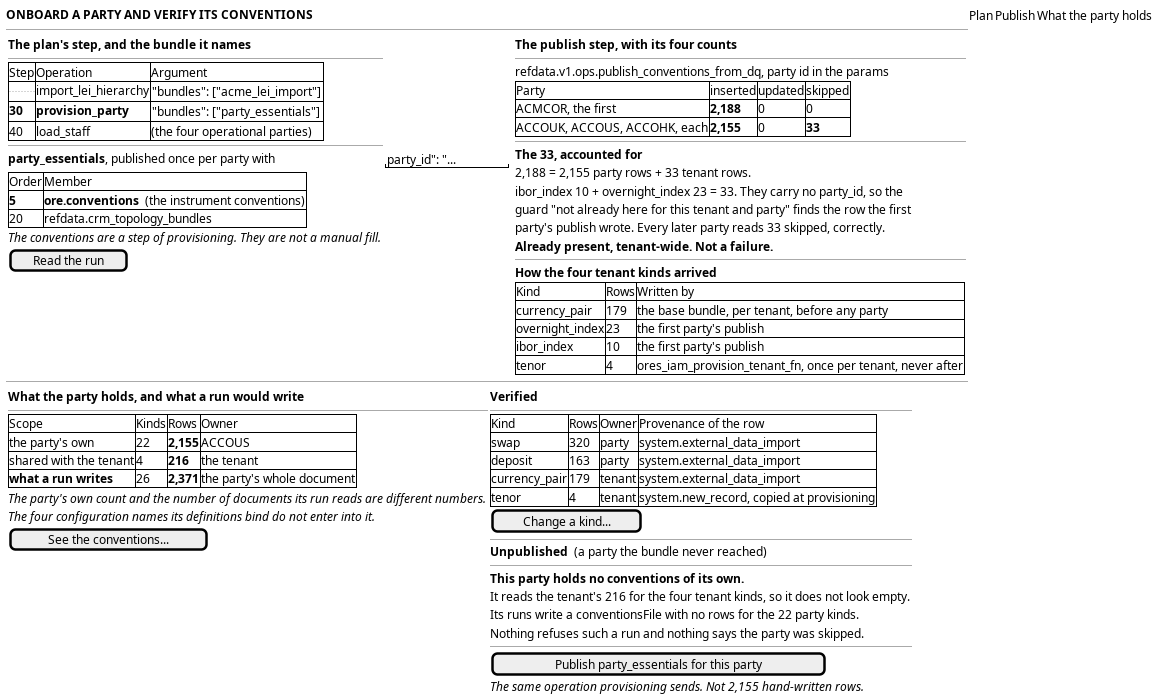
Figure 1: Onboard a party and verify its conventions: the provisioning run's publish step with its counts, the party's 2,155 own rows against the tenant's 216 shared ones, and the party the plan never reached with what a run would write.
5. Prototype
No prototype is written for this journey in this pass. The journey is a verification and its open questions are all about reads the server does not offer — a per-party expected count, a record that a party's conventions were published, and an attribution of the skip count. A prototype would draw three panels and fake all three numbers.
What a prototype must draw when the reads exist is stated here: the publish step's four counts, the party's own total beside the tenant's shared total, the per-kind table with the owning scope marked, and the unpublished party as its own state with the operation that fills it.
6. Entities composed
| Entity | What it contributes | Model |
|---|---|---|
| The 26 convention tables | What the party holds. 22 carry party_id; four do not, and a party reads the tenant's rows for those. |
one per kind; see below |
report_definition |
The definitions whose next run reads the file, and the party the export resolves | ores.reporting.report_definition |
party |
The party being verified, its short code and its parent | ores.refdata.party |
change_reason |
system.external_data_import for a published row and system.new_record for a copied one, which tells the two apart after the fact |
|
dataset_bundle, dataset_bundle_member |
The party_essentials bundle and its members, which is what decision "the run does this" rests on |
The two counts a party has, and why they are different:
| Scope | Kinds | Rows | Written by |
|---|---|---|---|
| The party's own | 22 | 2,155 | refdata.v1.ops.publish_conventions_from_dq, once per party, inside party_essentials |
| Shared with the tenant | 4 | 216 | currency_pair 179 by the base bundle; overnight_index 23 and ibor_index 10 by the first party's publish; tenor 4 by the tenant provisioner |
| Entity | What it contributes | Model |
|---|---|---|
swap_convention |
The kind a person checks first: 320 rows per party | ores.refdata.swap_convention |
deposit_convention |
163 rows per party | ores.refdata.deposit_convention |
ibor_index_convention |
One of the two tenant kinds whose rows the first party's publish writes | ores.refdata.ibor_index_convention |
overnight_index_convention |
The other one | ores.refdata.overnight_index_convention |
tenor_convention |
The kind no publish reaches, copied by the tenant provisioner | ores.refdata.tenor_convention |
currency_pair_convention |
The kind the base bundle publishes before any party exists |
ores.refdata.currency_pair_convention |
The party-scoped kinds are party-scoped by row-level security, so a party session reads its own rows and a tenant administrator reads the tenant's parties. That is why the verification screen can be one screen for both actors: the rows are the same rows and the policy is what narrows them.
7. Operations and messages
| Step | Operation | Subject | Status |
|---|---|---|---|
| Read the plan | Read the provisioning profile's steps | iam.v1.seed_profile_steps.list |
exists |
| Read the plan | Read the party-focused bundles | dq.v1.dataset_bundles.list |
exists |
| Read the plan | Read a bundle's members | dq.v1.dataset_bundle_members.list |
exists |
| Read the publish | Read the run's steps and their results | workflow.v1.ops.get_workflow_steps |
exists |
| Read the publish | List the provisioning instances | workflow.v1.instances.list |
exists |
| Read the party | List the tenant's parties | refdata.v1.parties.list |
exists |
| Verify | List the party's conventions of one kind | refdata.v1.<kind>_conventions.list |
exists |
| Verify | Read the party's whole conventions document | refdata.v1.conventions_documents.get |
exists, not reachable by a person |
| Verify | Read the party's definitions | reporting.v1.report_definitions.list |
exists |
| Fill a party nobody published | Publish the bundle for the party | dq.v1.ops.publish_bundle |
exists |
| Fill a party nobody published | Publish the dataset for the party | dq.v1.ops.publish_datasets |
exists |
| Verify | Read the party's own total against an expected total | (no read states a party's expected convention count) | missing |
| Verify | Read that a party's conventions were published | (nothing records it; the workflow step's counts are the only trace) | missing |
| Verify | Read one publish's counts per kind | (the function returns one total) | missing |
| The screen itself | Verify a party's conventions from the browser | (no BFF route) | missing |
The provisioning engine dispatches every plan step to one subject,
iam.v1.ops.provision_tenant_step, and the publish operation is one of the
operations that subject performs. The publish step's own command subject is
refdata.v1.ops.publish_conventions_from_dq, which is what the workflow step
records and what the person reads.
No BFF route serves this screen. This journey adds one, for example
GET /api/refdata/parties/<party-id>/conventions/verification, which returns
the party's per-kind counts, the tenant's counts for the four shared kinds, the
expected total for a party published from party_essentials, and the last
publish step's four counts.
8. What is missing
- Nothing records that a party's conventions were published. The publish's
only trace is the workflow step's
result_json, and the conventions rows themselves saysystem.external_data_importwhoever wrote them. So the question "did this party's conventions arrive" is answered by counting rows and comparing against a number the person has to know. A per-party marker, or a publication record keyed by party and dataset, would answer it directly. - No read states a party's expected convention count. The 2,155 is a fact about the curated dataset, derivable only by counting the artefact tables. A party is verified against a number the person computed elsewhere. No operation returns "this dataset should place these rows for this party".
- A party the plan never reached is indistinguishable from a healthy one at a glance. It holds 216 tenant rows and no party rows, and every per-kind list answers successfully with no rows. Nothing in the server reports the party as unpublished, so the screen must derive "unpublished" from an empty per-kind list and an expected count it does not have.
- A run for an unpublished party is not refused. The export writes a conventions file with no rows for the 22 party kinds and the run proceeds. What ORE does with such a file is ORE's affair, and nothing in the tree stops the run or warns the person. A precondition on the run, or a validation at export, is the missing guard.
- The 33 are unattributed on the receipt. The publish returns one
records_skippedand the person must know that two tenant-scoped kinds account for it. The same gap Publish conventions from data quality records, seen from the party end. - `refdata::conventions:read` is held by services and not by the person
verifying. It is held by
OreServiceandReportRun, so the one read that answers "what does this party's document hold" is closed to the tenant administrator who is verifying it, and they read 26 lists instead. - `tenor` is refreshed for no tenant after the first. Its 4 rows come from a
one-time copy at tenant creation. A tenant provisioned before a tenor
correction keeps the old rows forever and nothing says so; the only way to
refresh them is to write them with the per-kind
put. - A starting point other than
acme_demomay not name the bundle.party_essentialsis named by the plans that have one, and a party created outside a plan is published for by nobody. Nothing checks that a party has been through a plan that names the bundle, and nothing reports a party that has not.
9. Related journeys
- Publish conventions from data quality — the publish this journey verifies, and the act it hands to when a party was missed
- See the conventions a party uses — what the verified party's run will read
- Change the convention a party uses for one kind — a term this party needs differently from the curated set
- Author a convention for a kind — a term no curated document states
- See the reports a party runs — the definitions a new party's runs are, and the front door to them
- Run a report and watch it finish — the run that reads the file this journey verifies
10. Related knowledge
- Conventions journeys — the group this journey belongs to
- Provisioning operations and the plan — the starting point, the operations and the party bundle
- DQ artefacts — the bundle member and the publish subject the plan's step resolves
- Reference Data — the provenance a published row carries
- ORE Model Configuration — the conventions file the party's run writes
- User Journeys — the index
11. See also
- User Journey Extraction Standard — the checklist this journey is written against
- Document type: user_journey — the eleven sections this page fills
party_essentials— the bundle whose first member is the conventions datasetores_iam_provision_tenant_fn— the one-time copy of the tenor conventions