User Journey: See who changed a curve, and when
Table of Contents
This page documents a user journey: An auditor reads the trail of a published curve: its blueprint changes, its builds, its manual adjustments, its approvals and its publishes, each with an actor and a time.
A user journey describes what one person is trying to do, before anything is built. It is a design document that outlives any sprint, so it names the screens, the entity fields each screen shows, and the operations and messages each step needs.
1. Goal
"I want to be able to say who changed this published curve, what they changed, and who approved it, so I can answer a challenge and show the trail." The journey is done when the auditor holds the trail of one curve: every blueprint change, every build, every manual adjustment and every publish, each with an actor and a time, and can put one version beside the one before it.
2. Actor and trigger
The actor is the auditor, or reviewer: a signed-in person inside their tenant who holds a read permission on the market data entities and on the approval records. No dedicated auditor role holds only those reads today; see What is missing. The trigger is an internal or external challenge to a number a run used, a periodic review of how curves are governed, or a publication the person must attest. The journey starts at a market series, or from the evolution view, and ends when the person leaves the trail.
The record is bitemporal: each row carries the transaction time of its versions beside the financial time of the thing it describes. What the trail can show, and what it cannot, follows from which entities keep those versions; see What is missing.
3. Steps
- Open the trail. The person opens Market data, finds the series by its
oresmd_uri, and chooses Trail. The system shows the series row: the URI, the subclass, the derivation kind, the derivation config and its version, and the provenance of the row, which is who modified it, who performed it, the change reason code and the change commentary. - Read the blueprint changes. The system lists every version of the series row, newest first, with the field-level difference from the version before: when the derivation config or its version changed, and who changed it and why.
- Read the builds. The person opens the points. The system lists the series'
observations by observation time, with each point's
oresmd_uri, value, observation time and source. A build is many points written at one observation time under one source. - Read the per-point provenance. For a derived point the person reads its lineage: the derivation config and version, the source as-of, and the source series it read. Only a derived point has a lineage row; an observed point has none, and that absence is the observed marker.
- Read the manual adjustments. The person asks which points a person wrote rather than a feed. The system shows the points whose source is the internal manual adjustment source, beside the change reason on the record.
- Read the approvals. The person opens the approval requests and their decisions for the object: who asked, when and why, and who decided what and when. The generic approval record exists; no market-data approval kind does; see What is missing.
- Read the publishes. The system shows every publish of the curve: the version published, the person who published it, and the time. No publish operation exists, so this panel is empty by construction; see What is missing.
- Put one version against the one before. The person selects a version and the system shows it beside the version before, with the field-level difference. This exists for the series row; it does not exist for a point; see What is missing.
- Leave. The person goes back to the series or to the evolution view.
Every read is answered inside the reply. The trail carries no state of its own; it is a reading of the versions the server already keeps.
4. Screens and wireframes
One screen. The object and its provenance sit at the top, the blueprint versions and their differences sit under it, the builds, the per-point provenance and the manual adjustments sit in the middle, and the approvals and publishes sit at the bottom, so the person reads the object, then what was built, then who signed it off.
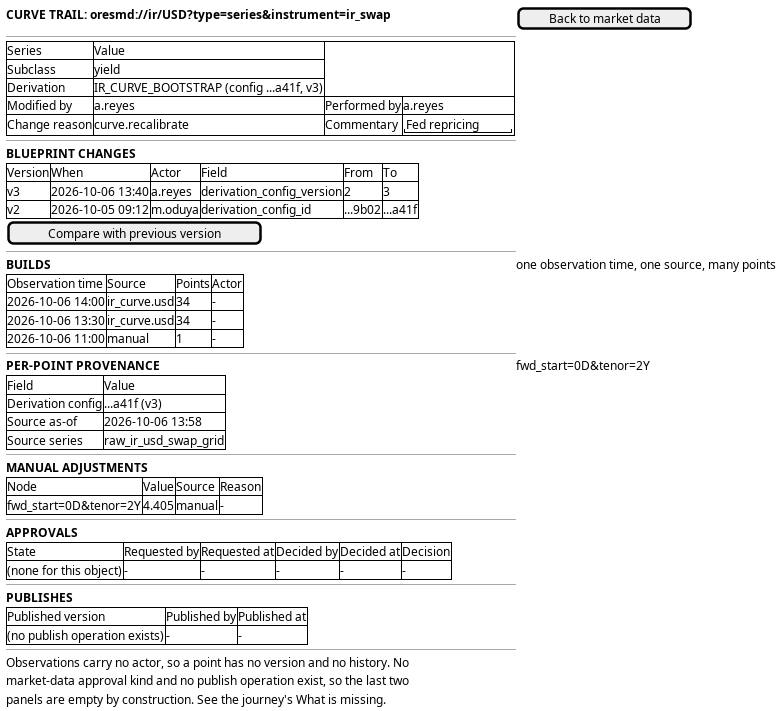
Figure 1: Curve trail: the series and its provenance, its blueprint versions with their differences, its builds and their lineage, its manual adjustments, and its approvals and publishes.
5. Prototype
A static page at doc/prototypes/market_data/see-who-changed-a-curve/index.html: mock data only, no backend,
no build step and no session. It argues that the trail of a curve: blueprint changes, builds, hand adjustments, approvals and publishes in one place, each with an actor.
- Variants
- a one merged timeline, b one table per kind, c a two-version compare
- States
- rich, empty (nothing published yet), manual (a hand adjustment with its actor)
- Source
doc/prototypes/market_data/see-who-changed-a-curve/index.html- Open
/OreStudio/doc/prototypes/market_data/see-who-changed-a-curve/once the site is built, or the file directly
6. Entities composed
| Entity | What it contributes | Model |
|---|---|---|
market_series |
The curve's identity and its derivation marker; its versions carry the blueprint changes | ores.marketdata.market_series |
market_observation |
The built and manually adjusted points, with observation time, value and source; the row carries no actor | ores.marketdata.market_observation |
observation_lineage |
The per-point provenance: the config and version, the source as-of, and the source series a derived point read | ores.marketdata.observation_lineage |
market_data_source |
The source behind a point, with its provider and kind, so a build's input can be named | |
approval_request |
Who asked for an approval, when and why, and where the request is | ores.inbox.approval_request |
approval_decision |
Who decided what and when, and the comment they left | ores.inbox.approval_decision |
approval_kind |
The rules of a kind: the decide permission, whether a comment is needed, how many approvals close it; no market-data kind exists | ores.inbox.approval_kind |
approval_decision_type |
What a decision does: approve, refuse, hold, resume, withdraw or reverse | ores.inbox.approval_decision_type |
approval_request_state |
Where a request is in its life, and whether that state is final | ores.inbox.approval_request_state |
The series, the lineage and the source are versioned, so each has a history and an actor per version. The observation rows are not: they are the tick-level table, and they carry no actor. The approval records are versioned and each decision is a row of its own.
7. Operations and messages
| Step | Operation | Subject | Status |
|---|---|---|---|
| Open the trail | Read the series | marketdata.v1.market_series.get |
exists |
| Open the trail | List the series' versions | marketdata.v1.market_series_versions.list |
exists |
| Read the blueprint changes | Read every version with its field diff | marketdata.v1.history.get |
exists |
| Read the builds | List a series' observations | marketdata.v1.market_observations.list_by_series_id |
exists |
| Read the builds | Read one observation | marketdata.v1.market_observations.get |
exists |
| Read the per-point provenance | Read the lineage of a point | marketdata.v1.observation_lineages.get |
partial |
| Read the per-point provenance | Name the source of a point | marketdata.v1.sources.list |
planned |
| Read the manual adjustments | Read the change reasons | dq.v1.change_reasons.list |
exists |
| Read the approvals | List the requests of a kind | inbox.v1.approval_requests.list_by_kind_code |
exists |
| Read the approvals | List a request's decisions | inbox.v1.approval_decisions.list_by_request_id |
exists |
| Read the publishes | Read the publish acts | no subject | missing |
| Put a version beside the one before | Read a version's diff | marketdata.v1.history.get |
exists |
| Read the history of a point | Read a point's versions | no subject | missing |
The history request is the generic one, addressed at the owning component's
subject, so the market data one is marketdata.v1.history.get with
entity_type ores.marketdata.market_series,
ores.marketdata.observation_lineage, ores.marketdata.market_data_subscription or
ores.marketdata.series_classification_rule. Those four register a history
provider. ores.marketdata.market_observation does not, because it has no
audit columns and a version must carry an actor as well as a time; see
What is missing. The lineage read is keyed by the lineage row's id, not by
the observation, so the screen needs the id before it can ask.
8. What is missing
- Observations carry no actor.
market_observationhas noversion,modified_by,performed_by,change_reason_codeorchange_commentary, because tick-level volumes made them impractical, so the market data registrar withholds a history provider for it. The candidate is a provider over the observation rows, or an actor and a change reason carried on the write. Until then the screen shows each point's observation time and source, and it cannot say who wrote a point or when it changed. - No publish operation and no publish event. Nothing publishes a curve, so the trail holds no publish acts. The bootstrap's republish writes the output series' observations directly, and its own protocol says the review and approval gate is a separate, later layer. The candidate is a publish operation with a published version, and a publish event. Until then the publishes panel is empty and the screen says that nothing is published.
- No market-data approval kind. The inbox holds one kind,
iam.role_grant; no kind names a curve publish or a manual adjustment, so no approval request can be raised for this object. The candidate is a market-data approval kind with its decide permission, its approvals-required count and its comment rule, and the operation that applies an approval. Until then the approvals panel can show only requests of another kind, and none names this object. - No candidate-against-published distinction. No field on an observation says whether it is a candidate or a published value, so the trail cannot separate the two. The candidate is a published version or a published flag. Until then the screen reads the market's values and does not claim which of them were published.
- No field diff for a point, and no lineage read by observation. The history
read returns versions with their difference for the four entities that
register a provider. It does not for
market_observation, andmarketdata.v1.observation_lineages.gettakes the lineage row's id, not the series, observation time and URI the repository's own lookup accepts. The candidate is a lineage read keyed by the observation. Until then the screen reads a lineage row by id when it has one, and matches the rest by hand. - The manual adjustments are not marked.
market_observationcarries a free-textsource, so a point a person wrote cannot be told from a point a feed wrote except by that string, and the write's change reason does not travel with the row because the entity keeps no version. The candidate is a manual marker, or a source convention the column validates. Until then the screen treats a source that names no producer channel as manual, and says the classification is a convention. - No auditor role. No role holds only the market data reads and the inbox reads this journey needs; a person reaches it through the read permissions they already hold. The candidate is an auditor role.
9. Related journeys
- Watch a curve or surface evolve — the values the trail explains
- Manage a curve's blueprint — the blueprint whose changes the trail shows
- Adjust a curve or surface by hand — the manual points the trail must name
- Ask for a publish to be approved — the request the approvals panel reads
- Decide a publish — the decision the approvals panel reads
- Publish the approved set — the act the publishes panel must record
- Withdraw or replace a published curve — the act that follows a publish, and must stay in the trail
- Watch the market and clear its exceptions — the market side of every build