ores.testing
Table of Contents
1. Diagram
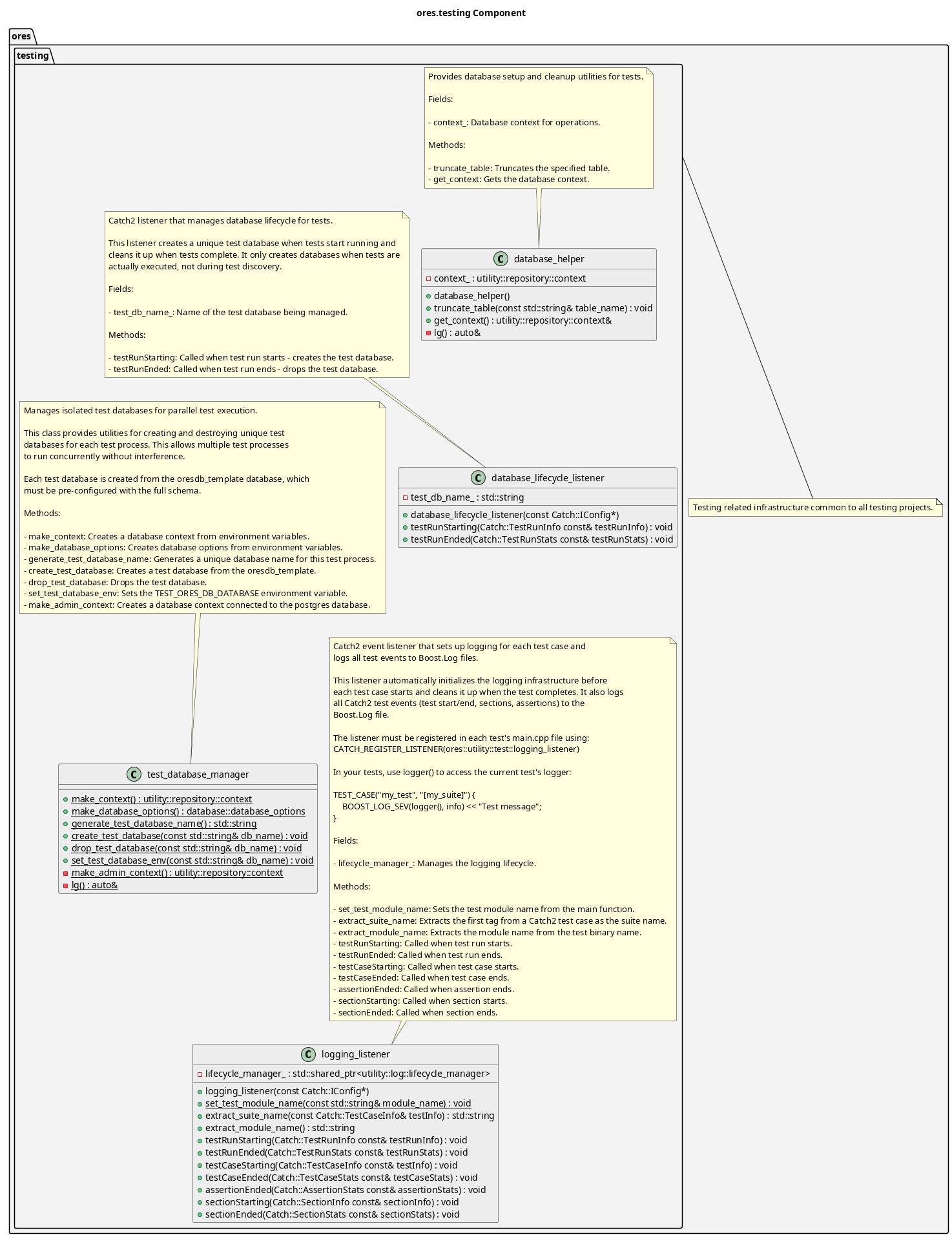
Figure 1: ores.testing
2. Summary
ores.testing is the shared infrastructure every ORE Studio test suite builds
on. Each test run gets its own PostgreSQL tenant inside one shared database, so
parallel suites cannot see each other's rows, and the tenant is terminated when
the run ends. The component routes Boost.Log output per test case, hands out
database contexts bound to the test tenant, and reads the SQL populate scripts
so that a suite asserts against the seed the loader actually writes. Its
consumers are the test binaries of the production components, never production
code.
3. Inputs
ORES_TEST_DB_*environment variables (or.env) with the database user, password, host, database, port and tenant.ORES_TEST_LOG_ENABLED,ORES_TEST_LOG_LEVEL,ORES_TEST_LOG_CONSOLEandORES_TEST_LOG_DATABASE, which switch per-test logging on and choose where it goes.ORES_TEST_TIMEOUT_SECONDS, the per-test watchdog budget, 60 seconds by default.ORES_NATS_URLand theORES_NATS_TLS_*trio, read into NATS connection options.- A Catch2 test runner that registers the listeners and sets its module name.
- The populate scripts under
projects/ores.sql/populate/, read throughproject_root.
4. Outputs
- A provisioned test tenant per run, terminated at the end of that run.
- Boost.Log records per test case under
../log/<module>/<suite>, written to a file and optionally to the console and to the telemetry database. - Database contexts bound to the test tenant, optionally carrying a minimal RBAC seed and party-scoped isolation.
- Domain objects parsed from a populate script, for a suite that asserts against the seed.
5. Entry points
include/ores.testing/ores.testing.hpp— the namespace documentation header.include/ores.testing/database_lifecycle_listener.hpp— provisions and terminates the test tenant.include/ores.testing/logging_listener.hpp— per-test Boost.Log routing.include/ores.testing/database_helper.hpp— tenant context, RBAC seed and party scope.include/ores.testing/scoped_database_helper.hpp— the RAII wrapper a test declares.include/ores.testing/make_generation_context.hpp— generation contexts for codegen tests.include/ores.testing/run_coroutine_test.hpp— drives one coroutine to completion and fails the case when it throws.
6. Dependencies
- Catch2 — the framework the listeners plug into.
- ores.database — the connection pool, and the tenant and party contexts.
- ores.logging — the logger factory every test translation unit calls, and the lifecycle manager the per-test listener drives.
- ores.nats — the connection
options
make_nats_options()builds. - ores.platform — environment access and the local-time conversion behind a test tenant code.
- ores.utility — the tenant identifier the helpers hand out, and the generation context they build.
- ores.marketdata.api and ores.ore.core — the domain types the seed readers return.
- ores.telemetry.core and ores.telemetry.database — the log lifecycle manager and the telemetry sink.
7. See also
- ores.database — the component whose contexts and tenant isolation the helpers build on.
- ores.logging — the logging lifecycle manager the per-test listener drives.
- ores.nats — the options the helper builds for a test that talks to the broker.
- Unit test conventions — the file, case and fixture conventions every suite here follows.
- System Model: Infrastructure Layer — the layer the component belongs to.
- Component Clean Standard — the checklist this component was brought to.
- Clean ores.testing to the component clean standard — the story that did the work.