User Journey: See a report's results by counterparty
Table of Contents
This page documents a user journey: A market-risk or credit reader opens one finished run and reads its results by counterparty: each counterparty's aggregate NPV, its notional, its trade count and, where the report runs saccr, its exposure, grouped through the parent counterparty.
A user journey describes what one person is trying to do, before anything is built. It is a design document that outlives any sprint, so it names the screens, the entity fields each screen shows, and the operations and messages each step needs.
1. Goal
"Which counterparties is this run exposed to, and how much of the run is each one?" The person has a finished run in front of them and needs the counterparty view of it rather than the book view: who the run faces, what each of them is worth to it, and which of them carry the concentration. The journey is done when they can name the counterparties that dominate the run, hand one of them to a colleague with its trades behind the number, and say what the run leaves out.
The book view answers a different question, and Read what a run produced owns it. The same run read by portfolio, book and trade is how a person reconciles their own book. Read by counterparty it is how they answer a limit question, a credit question, or a desk asking what one name contributed.
2. Actor and trigger
Two actors share this journey, and they read it for different reasons. A market-risk or credit person reads it after a limit question, or before signing off the party's exposure: they need the ranked view, the totals, and the name that is out of line. A trading-desk person reads it after a trade or a group of trades, asking what one counterparty contributed to the run and which of its trades moved the number.
Both act inside their own party. They arrive from a run's row on See the reports a party runs, or from the results panel of Run a report and watch it finish, or from the result of Read what a run produced by switching that result from its book reading to its counterparty reading.
The trigger is a run that has completed, and a question about who it faces. The journey starts when the person opens the counterparty view of that run and ends when they have the ranked counterparties, or one counterparty's trades, or the reason a name they expected is not there.
This is a read-only journey. It reads a run that already exists and changes nothing: no run, no definition and no counterparty record.
3. Steps
- Open the counterparty view of one run. The person is looking at a completed
run, and switches its result from the book reading to the counterparty
reading. The view is entered from the run's results, never from a global
counterparty list: a counterparty's own page answers "who is this name", and
this view answers "what did this run do with this name". The header keeps the
run in front of the person, so every figure below is a figure of that run and
of no other, and the panel names the analytics the run's report configuration
runs, because those decide which measures exist. A report that runs
npvalone has no exposure column; a report that runsnpvandsaccrhas both. - Read the counterparties the run is exposed to. The screen lists one row per
counterparty the run has a result for. Each row states the counterparty's
short code and its full name, its aggregate NPV, its notional, its trade
count and, where the report runs
saccr, its exposure. The aggregate NPV is the sum of theNPV(Base)of the trades the run attributes to that counterparty, the notional is the sum of those trades'Notional(Base), and the trade count is how many such trades the run holds. The ordering is stated on the screen and is the point of the step: the largest first, by exposure where the report runssaccrand by aggregate NPV where it does not. The person scans the top of that list and has the answer to "how much of the run is each one". A share of the run is shown beside the figure, so a row that is a tenth of the run reads as a tenth. - Group them, because counterparties nest. A counterparty carries
parent_counterparty_idonores_refdata_counterparties_tbl, so a banking group and its legal entities are both real, and both are meaningful to different readers: credit reads the group, the desk reads the entity it faces. The screen therefore draws a group and its members as one structure, with the group's own row carrying the sum over its members and each member carrying its own figure. A reader sees a group total and then expands it to the members that make it up, and the total is arithmetic: the group figure is the sum of its members plus the trades booked to the group itself, so a parent that disagrees with its children cannot appear. A counterparty whose parent is not in the run is drawn under a stated heading rather than promoted to a group of one, and a group whose members are all outside the run is drawn as a group with its own trades. - Open one counterparty. The person selects a counterparty, and the screen
shows what the number is made of: the trades the run attributes to that
counterparty, each with its trade id, its trade type, its notional and its
NPV, the netting sets those trades sit in, and any error the run recorded
against those trades. A trade in the result is the trading trade with that id,
so
trading.v1.trades.getis what resolves the row to the trade itself, and the trade names itscounterparty_id. The netting set is on the trade's booking,ores_trading_trade_bookings_tbl, which carriestrade_idandnetting_set_id, so a counterparty's exposure reads by netting set and a person can see which set carries the exposure rather than only the total. The errors are the run's own rows, read byreporting.v1.report_error_events.list_by_report_instance_idand filtered to the subjects the counterparty's trades name; their scopes areTrade,Analytics,Curve,ConfigurationandReport, and none of them is a counterparty, so a counterparty's errors are reached through its trades and never directly. A person who wants the errors as a set of their own follows Find out why a run went wrong. - Notice a name with no result, and a trade with no name. A counterparty the
party can see that the run has no result for is a stated case, not an
absence: it is listed with a zero trade count and a dash where the figures
would be, and the screen says plainly that the run produced nothing for it.
A trade that names no counterparty is the other stated case. The schema
allows it:
ores_trading_trades_tblcarriescounterparty_scopeand a check thatcounterparty_idmay be null only when the scope isintra_entity, so an intra-entity trade has no counterparty by design. The screen draws such a trade under a stated heading of its own, with its own notional and NPV, and says that the run's counterparty totals are therefore less than the run's total by that amount. Neither case is dropped, because a total that silently leaves out a name or a trade reconciles against nothing. - Leave, or go on. The person opens the trades behind one name, follows an error down, opens what the run produced, or goes back to the report's row. The view creates nothing and the next person who opens the run reads the same figures.
No step waits on the server after its reply, and the journey keeps no state of its own. It is a run of screens over immediate operations, so it needs no workflow instance.
4. Screens and wireframes
One screen. The run header, the ranked list, the group and member rows, the selected counterparty's trades and netting sets, and the errors against them are panels of that screen, because they are one answer: what this run faces and how much of it each name is. The screen is read-only: it creates nothing, changes nothing and destroys nothing.
The list is the screen. A person arrives with a question about concentration and leaves with a ranked answer, so the totals, the ordering rule and the share of the run each row carries are on the screen and not behind a control. The two stated cases sit below the ranked rows rather than inside them, because a name with no result is not a measure of zero and a trade with no name is not a counterparty.
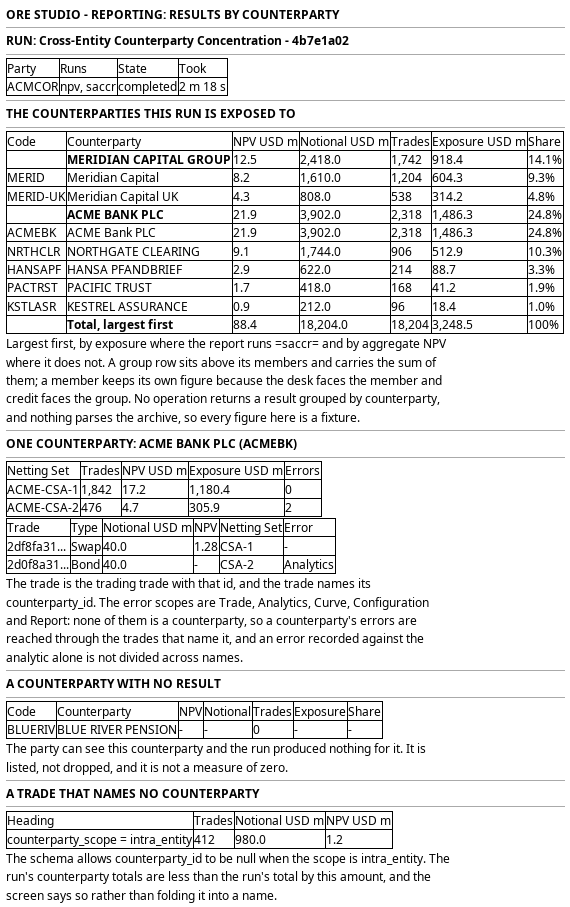
Figure 1: See a report's results by counterparty: the run's ranked counterparties with aggregate NPV, notional, trade count and exposure, a group above its members, one counterparty opened to its trades, netting sets and errors, a counterparty with no result, and a trade that names no counterparty.
The wireframe draws the three readings the prototype carries as variants: a ranked list with a group row above its members and the totals at the foot, a tree that expands a group into its members with a rolled-up aggregate at each node, and a map of the run as a proportional bar, each segment as wide as its counterparty's share, with the selected name read beside it.
5. Prototype
The prototype argues this journey in three interpretations, and its design note says what each argues and what is fake. This journey is the design intent for the counterparty view of a run's result, and its prototype belongs at doc/prototypes/reporting/see-a-reports-results-by-counterparty/, with hyphens because the inventory gate reads the directory name as a link.
The prototype must draw three structural readings of the same run. A draws one
ranked table, largest first, with a group row above its members and the totals at
the foot. B draws a tree grouped by parent counterparty, each node carrying its
rolled-up aggregate and expanding to its members, so a group total and its parts
are visible together. C draws a map of the run as a proportional bar, sized by
each counterparty's NPV, with the selected counterparty read beside it, for the
person asking how concentrated the run is.
In all three, every counterparty must state its aggregate NPV, its notional, its
trade count and, where the run's report runs saccr, its exposure,
and every row must carry both the short code and the full name, because a reader
uses one and recognises the other. Selecting a counterparty must show its trades
and the errors the run recorded against them. A counterparty with no result and a
trade that names no counterparty must each be drawn as a stated case rather than
dropped. A group must be drawn with at least two members, because a group of one
proves nothing about the roll-up.
Because no operation returns a result grouped by counterparty, and no operation
parses the run's archive, every figure on the page is a fixture and the panel
that draws it says so. The panel also states the two facts that make it a
fixture: nothing parses the archive, and npv.csv names the counterparty as a
name rather than an id.
6. Entities composed
| Entity | What it contributes | Model |
|---|---|---|
report_instance |
The run being read: its state, its kind, and the definition it came from. Every figure is a figure of this run | ores.reporting.report_instance |
report_definition |
The definition behind the run, whose report configuration decides which analytics ran and therefore whether there is an exposure column | ores.reporting.report_definition |
counterparty |
The row: short code, full name, and parent_counterparty_id, which is what makes a group and its members |
ores.refdata.counterparty |
party_counterparty |
Which counterparties the party can see, so a name with no result can still be listed as a stated case | ores.refdata.party_counterparty |
trade |
The trades behind a counterparty's aggregate: counterparty_id, counterparty_scope, trade type and notional |
ores.trading.trade |
netting_set |
The sets the trades sit in, which is the level at which an exposure is reported | ores.refdata.netting_set |
report_error_event |
The errors recorded against the trades a counterparty contributed: severity, scope and message | ores.reporting.report_error_event |
report_error_scope |
The vocabulary the errors are placed by, none of whose members is a counterparty | ores.reporting.report_error_scope |
party |
The owner of the run and of the counterparty visibility rows | ores.refdata.party |
The run is the scope; the counterparty is the row. Neither the aggregate NPV, the
notional, the trade count nor the exposure is a stored field: every one of them
is derived from the run's result rows and the trades behind them, and What is
missing states the reads that would spare the screen that work. The grouping is
not stored either: parent_counterparty_id is on the counterparty, so the screen
assembles the tree from the counterparty records it reads.
A trade's netting set is not on the trade. ores_trading_trades_tbl carries the
party, the counterparty and the trade type;
ores_trading_trade_bookings_tbl carries trade_id, book_id and
netting_set_id, and it versions on its own timeline, so a re-papering into
another netting set cuts a new version of the booking and leaves the trade alone.
The screen reads the booking current at the run, which is the booking whose
window covers the run's start.
The counterparty and the party are party-scoped by row-level security, and the run and the definition are bitemporal, so the names the run's own records carry are the names of the run and not of today's edit.
7. Operations and messages
| Step | Operation | Subject | Status |
|---|---|---|---|
| Open the run's view | Read the run | reporting.v1.report_instances.get |
exists |
| Open the run's view | List the runs of a definition, to reach the run | reporting.v1.report_instances.list |
exists |
| Open the run's view | Read the run's errors | reporting.v1.report_error_events.list_by_report_instance_id |
exists |
| Read the counterparties | List the counterparty records the rows resolve to | refdata.v1.counterparties.list |
exists |
| Read the counterparties | Read one counterparty, and its parent_counterparty_id |
refdata.v1.counterparties.get |
exists |
| Read the counterparties | List the counterparties the party can see, so a name with no result can be stated | refdata.v1.party_counterparties.list_by_party_id |
exists |
| Read the counterparties | Read the run's results grouped by counterparty | (no operation returns results grouped by counterparty) | missing |
| Read the counterparties | Read each counterparty's aggregate NPV, notional and trade count | (no operation parses the archive) | missing |
| Group them | Read a counterparty's parent, and so build the group tree | carried by refdata.v1.counterparties.list and refdata.v1.counterparties.get |
exists |
| Group them | Roll a group's aggregate up from its members | (the screen sums the rows; no operation rolls up a group) | missing |
| Open one counterparty | List the trades the run attributes to a counterparty | trading.v1.trades.list |
exists |
| Open one counterparty | Read the trade a result row names | trading.v1.trades.get |
exists |
| Open one counterparty | List the trades' bookings, and so each trade's netting_set_id |
trading.v1.trade_bookings.list |
exists |
| Open one counterparty | Read the exposure a saccr run reported for a netting set |
(no operation parses the archive) | missing |
| Open one counterparty | Read the errors recorded against a counterparty's trades | reporting.v1.report_error_events.list_by_report_instance_id |
exists |
| Open one counterparty | Read the errors recorded against a counterparty | (the error scopes carry no counterparty) | missing |
| Notice a name with no result | List the party's counterparties, to find the ones the run omits | refdata.v1.party_counterparties.list_by_party_id |
exists |
| Notice a trade with no name | Find the trades whose counterparty_id is null |
trading.v1.trades.list |
exists |
| The screen itself | Read a run's results by counterparty from the browser | (no BFF route) | missing |
The run, the definition and the errors are reads the reporting service already
serves. The counterparty records are reference data reads. The trades and their
bookings are trading reads, and trades.list takes a filter record that carries
counterparty_id, so one counterparty's trades in the party are one read rather
than the whole population filtered in the browser.
The netting sets come free with the reads above: a trade's booking carries
netting_set_id, and the run's own result row carries the netting set's name in
NettingSet. The screen groups a counterparty's exposure by that name and does
not need the netting set's own record to rank one counterparty against another.
The attribution is the hard part, and it is two joins the platform does not
serve as one. A result row in npv.csv names the counterparty as a name. The
trade's own counterparty_id is the id, reached through
trading.v1.trades.get, and the safety of the join rests on it. Neither the
group roll-up nor a counterparty's totals is a stored field, so the screen does
the arithmetic from the result rows and says so.
The reads are gated by reporting::report_instances:read and
reporting::report_error_events:read for the run and its errors, and by
refdata::counterparties:read and trading::trades:read for the records the
rows resolve to. The error reads are held by no role below TenantAdmin and
SuperAdmin, and those two hold *. A credit reader who can see the
counterparty and its trades therefore cannot read why one of them failed, which
What is missing states rather than paper over.
No BFF route serves reporting. The prototype adds one, for example
GET /api/reporting/runs/<run-id>/counterparties, which returns the run's
counterparty rows with their aggregates, the grouping, and the stated cases. The
handler authenticates the caller's token and checks the read codes above.
8. What is missing
- No operation returns results grouped by counterparty. The archive holds
npv.csv, and its columns are exactlyTradeId,TradeType,Maturity,MaturityTime,NPV,NpvCurrency,NPV(Base),BaseCurrency,Notional,NotionalCurrency,Notional(Base),NettingSetandCounterParty. Nothing parses it.ores_compute_results_tblholds the archive'soutput_uri, itsoutcomeand itserror_message, and it holds no parsed rows, so the aggregate NPV, the notional and the trade count of one counterparty have no read behind them, and neither does the exposure asaccrrun reports. Every figure on this screen waits on a result store or an archive read, and the prototype draws each one as a stated fixture. npv.csvnames the counterparty, it does not identify it. The file'sCounterPartycolumn carries a name, and no id. Attributing a result row to a counterparty record therefore needs the trade'scounterparty_id, whichtrading.v1.trades.getreturns, and the netting set the trade sits in, whichtrading.v1.trade_bookings.listreturns; the alternative is a match on the name, and a name match is not safe: two legal entities of one group can share a name,full_nameis not unique in the tenant, and the file's spelling is the engine's rather than the record's. The one thing the name is good for is a warning when it disagrees with the trade's record, and the screen should show that disagreement rather than resolve it silently.- No read returns a counterparty's errors. The error model has no counterparty
subject: the scopes it places errors by are exactly
Trade,Analytics,Curve,ConfigurationandReport, so an error is recorded against a trade, an analytic, a curve, the configuration or the run, and never against a counterparty. A counterparty's errors are reached only through the trades that name it, by reading the run's errors and filtering them to the trade ids the counterparty contributed. An error recorded against an analytic alone cannot be attributed to a counterparty at all, and the screen says so instead of dividing it across names. - No BFF route serves reporting. Nothing in the web application shows a report today, so the counterparty view is a new route and a new screen as well as a new read.
- No read rolls a group up.
parent_counterparty_idis on the counterparty record, andcounterparties.listcarries it, so the screen can build the group tree. No operation sums a group, and there is no read of the counterparties under a parent counterparty: a client assembles the tree from the full list. The roll-up is the screen's arithmetic, and the screen must state that the group figure and its members' figures come from the same rows, so a reader can check one against the other. - The booking that gave the netting set is versioned, and the run names no version. A re-papering into another netting set cuts a new version of the trade's booking, and the run carries no booking version and no as-of time, so the screen reads the booking current when it draws and can disagree with the netting set the engine actually used.
- A trade with no counterparty is legal, and nothing reports the size of the
gap.
ores_trading_trades_tblallowscounterparty_idto be null whencounterparty_scopeisintra_entity, so a run can hold a trade that no counterparty claims. The screen draws it as a stated case, and the run's own total is the only figure that says how much of the run sits outside every counterparty. - The error permissions sit too high.
reporting::report_error_events:readis held by no role belowTenantAdminandSuperAdmin. A credit reader who can open the counterparty view and its trades cannot read the errors that say what is missing from their figures, which is the one warning this screen exists to carry alongside the number.
9. Related journeys
- Read what a run produced — the same run read by book and by trade, and the panel this view is a second reading of
- Find out why a run went wrong — the errors against a counterparty's trades, read as a set of their own rather than as a footnote to one name
- See the reports a party runs — the front door that leads to the run this view belongs to
- Run a report and watch it finish — the run that produced these figures, and the terminal panel it lands on
- Look back over a report's history — the earlier runs of the same report, when the question is how a counterparty's share moved
10. Related knowledge
- Reporting journeys — the group this journey belongs to
- Report execution pipeline — the phases that produce the archive this view reads
- Report post-processing — what reading the archive, and so grouping it by counterparty, will become
- Report pages — what each report's output is meant to be, and which of them run
saccr - ores.reporting — the component
- Journey execution — how the screen composes its reads
- User Journeys — the index
11. See also
- User Journey Extraction Standard — the checklist this journey is written against
- Task: Extract the ores.reporting user journeys — the work that owns it
- Headline Position — the report a desk reads by book, and the one this view is read beside
- UX — the standard the screen follows